
- Features
- Resources
- Pricing
- Try Trainn's AI Video Agent


Product
Usecases
Resources
Case Studies
Company
- Customers
- Pricing
- Try Trainn's AI Video Agent
- Expert voices
- Log in
- Book a demo
- Sign up →
Published on: 26 May , 2026
How to Build a Knowledge Base of Step-by-Step Guides
On this page
Most support teams don't have a knowledge base problem. They have a step-by-step guide problem. The guides are missing, written in product language no customer searches for, or out of date the moment a feature ships. 81% of customers try to resolve their issue on their own before contacting support (Zendesk CX Trends Report). When the step-by-step guides aren't accurate or findable, those customers file a ticket instead. This article covers the full process — which guides to create first, how to write each one well, how to build a library of them without writing every word manually, and how to keep them working as your product changes.
What It Means to Build a Knowledge Base of Step-by-Step Guides
A knowledge base of step-by-step guides is a searchable, customer-facing library of product workflows. Each entry breaks a task into numbered steps — with a description and annotated screenshot per step — so customers can complete it without contacting support.
To build one that actually deflects tickets, six things need to work together:
- The right guides — mapped to your most common support tickets, not your feature list
- Well-written steps — one action per step, with a screenshot that confirms the customer is in the right place
- A logical structure — organised by what customers are trying to do, not how your product is built
- A fast creation workflow — that produces a finished guide in minutes, not hours
- A maintenance plan — that keeps guides accurate every time your product changes
- In-app delivery — so customers find guides where they're actually confused, not at a URL they have to navigate to
Miss any one of these, and a knowledge base of step-by-step guides either never gets built, or stops working within a few months of launch.
Step 1: Decide Which Step-by-Step Guides to Create First
Start with your most-filed support tickets — not your product's feature list.
Pull the ten most common ticket topics from the past 90 days. These become your first ten step-by-step guides. A knowledge base built from ticket data deflects tickets from day one. A knowledge base organised around product features produces documentation for product managers, not answers for confused customers.
Once you have your initial list, map each guide to where it fits in the customer journey. This ensures your library covers the full customer lifecycle — not just onboarding, and not just the features your team prefers to document.
| Customer Stage | Guide Type | Example Topics |
|---|---|---|
| Onboarding | First-use setup guides | Account setup, connecting integrations, inviting teammates |
| Activation | Core workflow guides | Creating a record, running a report, submitting a form |
| Adoption | Advanced feature guides | Setting up automation, configuring permissions, managing custom fields |
| Ongoing use | Troubleshooting guides | Why isn't X working, how to reset Y, how to recover Z |
| Admin / IT | Configuration guides | SSO setup, API keys, billing management |
Write Guide Titles the Way Customers Search
The title of each step-by-step guide is the search query. Customers type what they're confused about — in plain, task-oriented language. Titles written in product language get skipped.
| Don't Use (Product Language) | Use Instead (Customer Language) |
|---|---|
| Data Management | How do I export my data? |
| User Administration | How do I add a new team member? |
| Notification Settings | How do I turn off email alerts? |
| Integration Overview | How do I connect my CRM? |
| Workspace Configuration | How do I change my account name? |
This framing matters beyond your help center search. ChatGPT, Google AI Overviews, and Perplexity pull answers from pages that match natural-language queries. A step-by-step guide titled and structured as a direct answer to a question is far more likely to appear in AI-generated responses than one titled as a feature name.
Step 2: Write Step-by-Step Guides That Customers Follow to the End
Each step must describe exactly one action — with a title, description, annotated screenshot, and outcome confirmation.
Most guides that get abandoned aren't abandoned because customers give up. They're abandoned because a specific step isn't clear enough to act on. The customer pauses, loses confidence, and closes the tab. That pause becomes a support ticket.
The Anatomy of a Step That Works
| Step Element | What It Does | Common Mistake |
|---|---|---|
| Step title | Names the action in task-oriented language | Describing what happened, not what to do next |
| Step description | Explains what to click, type, or select — and why, if it isn't obvious | Too vague ("click the button") or too long (paragraph of context) |
| Annotated screenshot | Shows exactly which UI element the step refers to | No annotation, or screenshot from an outdated version of the UI |
| Outcome confirmation | Tells the customer what they should see after completing the step | Left out entirely — the customer doesn't know if they did it right |
Here is Trainn’s 'How to Share Your Videos?' guide, showing the four elements above in practice.
When any of these four elements is missing, customers pause. A pause at step three of a seven-step guide usually produces a support ticket, not a completion.
Keep Each Guide to One Task
Guides that cover more than one task have lower completion rates. If a guide runs beyond eight to ten steps, it almost always covers more than one task.
Break it at the natural completion point — the moment a customer would pause and feel a sense of progress. Then link directly to the next guide. Nielsen Norman Group's research on procedural usability is consistent: users completing a task want to know when they've finished a phase. A 22-step guide reads as one enormous task. Four five-step guides, each answering one question, read as four completable tasks.
What 6,300+ Trainn guides tell us about guide length
Across the guides published on Trainn:
- The most common guide length is 11 steps — the single most-used number across the library, landing exactly in the 8–11 step range that signals a well-scoped single task.
- Four of the top five most common lengths — 9, 11, 13, and 15 steps — sit in the 9-to-15-step band. When focused single-task guides get published, this is the band they cluster in.
- The longer-tail guides — 20, 30, or 50+ steps — almost always cover more than one task. Each of those would land better as two or three shorter guides linked together.
Step 3: Create Step-by-Step Guides at Scale Without Writing Everything Manually
The bottleneck in most knowledge bases is the time it takes to create each guide.
Writing a step-by-step guide by hand — every step typed, every screenshot captured, every annotation drawn — takes 45 minutes to an hour per guide. At that pace, a library of 50 guides takes a week of dedicated work. Most CS teams don't have that week. The knowledge base stays half-built, and the tickets keep coming.
The way out is a creation workflow that removes writing and screenshotting from the process entirely.
How Trainn Generates Step-by-Step Guides Automatically
With Trainn's step-by-step guides feature, you record the product workflow once. Trainn handles the rest:
- Detects every click, input, and navigation action as a separate step
- AI generates a contextual title and description for each step — no writing required
- Adds zoom effects and spotlight highlights to the key UI element in each screenshot
- Outputs a finished step-by-step guide with annotated screenshots, ready to publish
A guide that takes 45–60 minutes to write manually takes under 10 minutes with Trainn. That difference is what makes it possible to build a library of 100 step-by-step guides in weeks, not months.
When a step needs adjusting — the description needs more detail, or a screenshot needs to be retaken — you edit that step inline without re-recording the whole workflow.
"Record your product once and Trainn automatically generates instructional videos and product guides. The average time to publish? Just 5 minutes." — Trainn
Step 4: Organise Your Knowledge Base So Customers Find Guides
Organise your knowledge base by what customers are trying to do — not by how your product is built.
Customers browsing a help center are not thinking in product modules. They are thinking in tasks: "I need to add someone," "I need to export this," "something isn't working." A knowledge base organised around product architecture serves the product team. One organised around customer tasks serves the customer.
Three Organisational Models That Work
By customer task works best for single-product SaaS. Sections correspond to goals: Getting Started, Managing Your Account, Running Reports. Customers navigate to the section for what they're trying to accomplish.
By product area works when customers clearly self-identify with a module — "I use the reporting tool" — and your module names match what customers call them. It breaks down when internal product names differ from how customers describe what they use.
By customer type works best for multi-role products. Separate sections for different roles — Admin guides, End-user guides, IT setup guides — reduce cognitive load for customers who only need guides relevant to their access level.
What Good vs. Weak Structure Looks Like
| Element | Strong Structure | Weak Structure |
|---|---|---|
| Top-level categories | 4–6 sections matching customer tasks or roles | 12+ sections matching product feature names |
| Guide titles | "How do I…" / "Why can't I…" phrasing | Feature names, internal product terms |
| Guide length | One task, 8-11 steps | Multiple tasks, 15+ steps |
| Navigation depth | Any guide reachable in ≤ 2 clicks | 4+ clicks to reach a specific guide |
| Related guide links | Each guide links to the next logical task | Guides are isolated, no onward path |
| Search | Returns results by keyword and task intent | Returns exact title matches only |
Step 5: Keep Step-by-Step Guides Accurate When Your Product Changes
Every product release is an opportunity for a step-by-step guide to show a screenshot that no longer matches the customer's screen.
SaaS products ship updates every two to four weeks. When a UI element moves, a button is renamed, or a workflow changes, every guide that covers that area becomes inaccurate. If those guides were written manually, updating them requires the same effort as creating them. That debt compounds faster than most teams can pay it down.
72% of customers prefer finding answers on their own rather than contacting support (Forrester Research). When those customers open a step-by-step guide and the screenshot at step two doesn't match their screen, they don't try a different guide — they lose trust in the knowledge base and file a ticket.
Build a Maintenance Trigger Into Your Release Process
Assign an owner to each section of your knowledge base. Every product release that changes a UI element, renames a feature, or modifies a workflow should flag the affected guides for review. Set a review window — completed before the release ships, not discovered by a customer after.
When updating a guide, review each of these:
| What to Review | What to Update |
|---|---|
| Screenshots at each step | Replace any showing outdated UI elements |
| Step descriptions | Revise references to renamed menus, buttons, or fields |
| Step count | Add steps if the workflow gained required actions; remove if it was simplified |
| Outcome confirmations | Update if the confirmation screen or message changed |
| Related guide links | Verify that linked guides are also still accurate |
With Trainn, updating a step-by-step guide means editing the affected step inline — swap the screenshot, revise the description — and publishing. The update propagates instantly to every place the guide is live: the knowledge base, in-app widget, and any course it is part of. No re-recording. No re-publishing separately to each channel.
"When a new feature is out, we just update a couple of slides on the video, push the video live in 10 minutes, and customers can benefit right away. Educating 12,000 customers in real-time felt easy." — Shambhavi Pandey, General Manager, Restroworks
Step 6: Deliver Step-by-Step Guides Inside the Product, Not Just at a URL
In-app delivery is where ticket deflection actually happens — not at an external help center.
A knowledge base at help.yourcompany.com requires customers to know it exists, remember the URL, leave the product, and search for what they need — all while they are mid-workflow and confused. Most customers don't do this. They file a ticket instead.
Gartner's research on self-service identifies contextual, in-product help as the highest-deflection model. Self-service costs $0.10 per contact versus $8.01 for live agent support — an 80x cost gap (Gartner). But that gap only closes when the help is in front of customers where confusion happens.
Both surfaces serve a role. The external knowledge base supports SEO, pre-sale research, and customers who prefer to browse on their own. The in-app widget catches customers mid-workflow, at the exact moment they're stuck, without requiring them to leave the product. Both are needed — but in-app delivery is what produces consistent ticket deflection.
Trainn's in-app tutorials widget embeds your full library of step-by-step guides inside your product without engineering. Setup takes approximately 20 seconds. The right guide appears where the customer is confused — no tab-switching required.
Step 7: Measure Whether Your Step-by-Step Guides Are Working
Track completion rate and per-step drop-off — not just page views.
Page views tell you a guide was opened. They don't tell you whether it helped. Completion rate tells you whether customers followed it to the end. Per-step drop-off tells you exactly which step caused them to stop.
| Metric | What It Measures | What Low Performance Signals |
|---|---|---|
| Guide view count | Is the guide discoverable? | Guide not surfaced in search or in-app; title doesn't match search intent |
| Guide completion rate | Is the guide clear enough to follow? | A step is confusing, outdated, or too vague |
| Per-step drop-off | Which specific step causes customers to abandon? | That step needs a better description or a retaken screenshot |
| Follow-up ticket rate | Did the guide actually resolve the problem? | Guide answers the wrong question, or stops one step too early |
| In-app vs. help center access | Where are customers finding guides? | Most access is external — in-app delivery needs improvement |
A benchmark for “good” based on 6,300+ guides and 61,000+ learner sessions on Trainn
Most teams measuring guide performance for the first time don't know what "good" looks like. Trainn's own data offers a baseline: across 61,000+ learner sessions, 69% of customers who start a guide complete it end-to-end, and 82% get at least halfway through.
Use those as soft benchmarks, not hard targets. A guide landing at 50% completion isn't broken — but it's worth opening to see where the drop-off is. A guide landing at 20% probably has a specific step that's confusing the customer enough to send them to support instead.
When a guide has high views and low completion, it is findable but not followable. When it has high completion but high follow-up tickets, it is answering the wrong question. Both problems are fixable — but only if you are measuring at the guide level, not just tracking total knowledge base traffic.
Trainn's analytics dashboard surfaces all five metrics per step-by-step guide, across every delivery channel. Support leads can see which guides are actively deflecting tickets and which ones need to be improved — without waiting for a quarterly review to surface the issue.
How Trainn Uses This Playbook for Its Own Knowledge Base
We didn't write this guide as theory. Trainn's own customer-facing knowledge base was built using the same playbook covered above. Here's what it looks like in practice, with real numbers from January 2025 to May 2026.
The hub holds 77 published step-by-step guides organised across seven product areas: Video Creation, Guides, In-App Tutorials, Knowledge Hub, Academy, Administration, and Release Notes. Each section follows the "Starter Kit → Editing → Sharing → FAQs" structure — so a customer landing on Video Creation can either learn from scratch or jump straight to a specific question. Over the 17 months covered here, the knowledge base served 5,152 content views from 1,603 unique visitors, with an average engagement time of 3 minutes 32 seconds per session.
image showing Trainn knowledge base analytics

[SCREENSHOT: Trainn Knowledge Hub Analytics dashboard — Total Views 5,152 / Unique Visitors 1,603 / Avg Engagement 3m 32s / Total Training Time Saved 94hrs 41m]
A few patterns from the data that map directly to the advice in this article:
-
A small number of guides do most of the work
Across 77 published guides, the top 10 alone drive roughly 12% of all views. The most-viewed guide — "Navigating Trainn's Video Creation Tool" — pulled 155 views with an average engagement time of 7 minutes 17 seconds, suggesting customers use it as a true learning resource rather than a quick lookup. The rest of the top 5 ("Types of user roles," "How to share & Export videos using Trainn," "Adding new users," "Upgrade Trainn subscription") cover the moments where customers most often get stuck — onboarding, sharing content, managing access, and billing.
This is the playbook from Step 1 in action: build guides around what customers are actively confused about, not around what your product team finds easiest to document. Ticket data points you to those topics. The view counts then validate that you picked right.
Image showing top performing guides in Trainn's knowledge base

[SCREENSHOT: Top Performing Guides — Knowledge Hub]
Different guide types serve different jobs
Engagement times across Trainn's top guides vary by an order of magnitude — from 7 minutes 17 seconds on a deep learning guide ("Navigating Trainn's Video Creation Tool") to 28 seconds on a focused task ("How to Share Your Videos?"). Both are working correctly. A customer searching "how do I share a video" wants the answer in under a minute. A customer exploring how to use the creation tool is doing structured learning.
The takeaway for your knowledge base: don't optimise every guide for the same engagement number. Optimise quick-task guides for fast completion. Optimise learning guides for depth and time spent.
What the dashboard tells us about the broader library
Beyond the top 10, Trainn's knowledge base shows the classic long-tail pattern — most guides land in the 1-15 view range over 17 months. That isn't a sign those guides are failing. It's a sign that each one serves a specific customer question that comes up occasionally rather than constantly. The right benchmark for a knowledge base isn't "every guide gets thousands of views." It's "every guide answers a real question that, when it comes up, gets answered in seconds instead of becoming a ticket."
Over the full 17-month window, Trainn's knowledge base added up to 94 hours and 41 minutes of cumulative learner engagement — time customers spent self-serving in the help center rather than waiting in a support queue.
The Business Case: What a Knowledge Base of Step-by-Step Guides Is Worth
| Metric | Source | Figure |
|---|---|---|
| Customers who try self-service before calling support | Zendesk CX Trends Report | 81% |
| Customers who prefer finding answers independently | Forrester Research | 72% |
| Cost per self-service contact | Gartner | $0.10 |
| Cost per live agent contact | Gartner | $8.01 |
| Cost gap between self-service and live support | Gartner | 80x |
| Monthly savings for a 3,000-ticket team at 40% deflection | At $15–$20 per ticket | $18,000–$24,000 |
| Annual savings at the same deflection rate | At $15–$20 per ticket | $216,000–$288,000 |
For most SaaS CS teams, the investment in building a library of step-by-step guides is a rounding error compared to the cost of not having one.
How Trainn Helps You Build a Knowledge Base of Step-by-Step Guides
Trainn handles both layers — guide creation and delivery — from a single platform. Here is how to go from a blank library to a published, searchable knowledge base with an in-app widget, without writing a single guide manually.
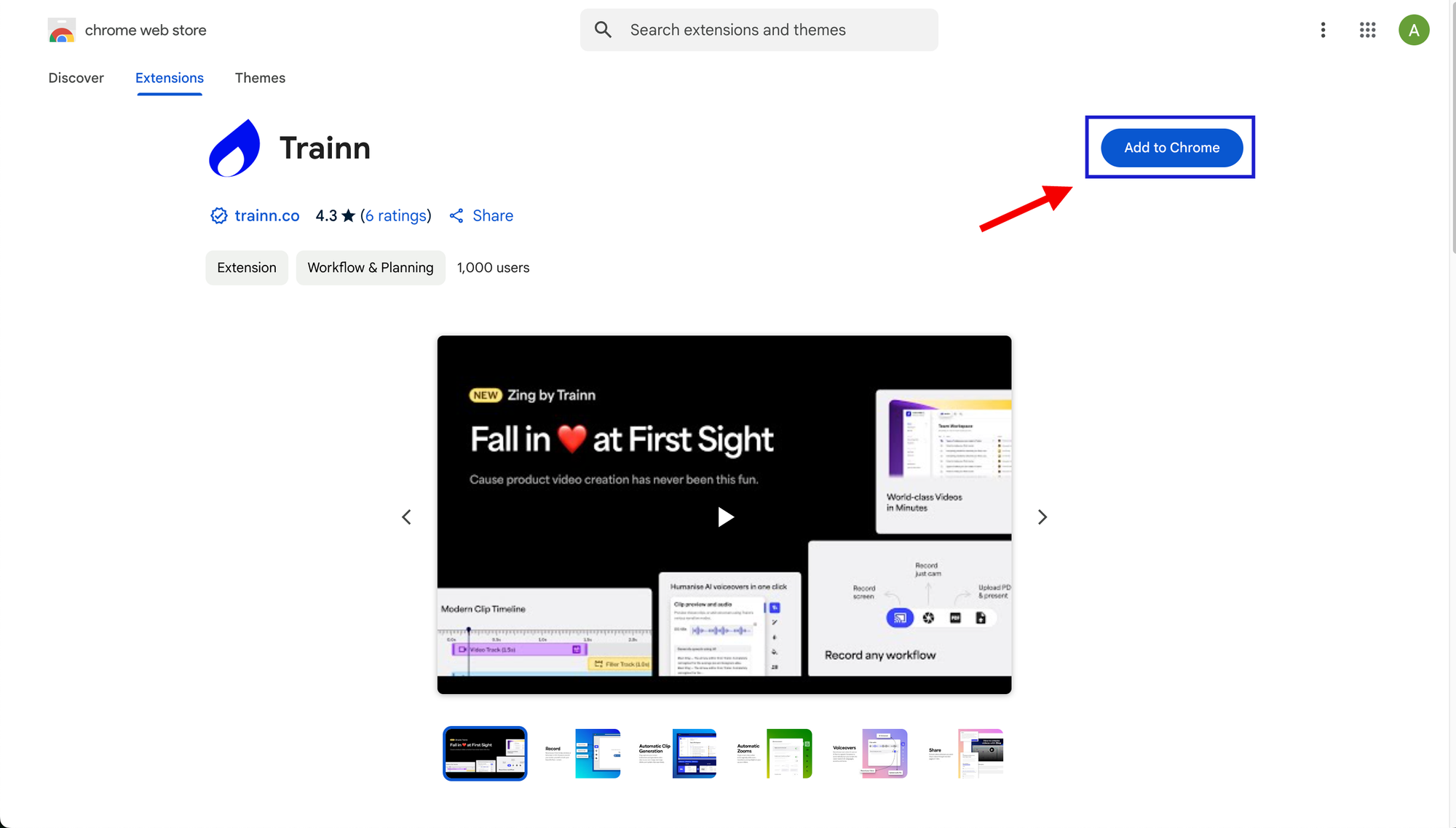
Step 1: Install the Trainn Chrome extension.
Download the Trainn Chrome extension — it is the starting point for recording guides into your knowledge base.
Step 2: Open Trainn and create a new guide
Go to the Library page. Click 'Create' and select 'Create Guide'.
Image showing Open-Trainn-and-your-Product-workflow

Step 3: Record the product workflow
Click 'Record'. Select the tab you want to record and proceed with 'Share' to start recording. Perform the workflow the way you would normally show it to a customer.
Image showing to record the workflow

Step 4: Stop recording and the step-by-step guide is generated.
Click 'Stop sharing'. Trainn automatically captures every action and generates screenshots with zooms and spotlights to highlight each action and contextual step descriptions.
Image showing Stop-recording

Step 5: Review, edit, and publish
Review each step individually — swap screenshots, adjust zooms or spotlights, edit descriptions, blur sensitive data, and reorder steps as needed. Once done, Publish the guide
image showing to Review-and-edit

Step 6:Organise guides into collections
Group related step-by-step guides into different collections for specific use cases, or features for onboarding flows and feature adoption sequences. Image showing to Organize into collections

Step 7: Publish your knowledge base and embed the in-app widget
Add your collections to the knowledge base and publish it. You can also embed the knowledge base directly inside your product using the in-app widget - without relying on developers.
Step 8: Track and iterate.
Monitor per-guide views, step-level drop-off, and completion rates. Use the data to identify which guides need improvement, which topics are missing, and which customer segments are engaging with the knowledge base. A guide with high views and low completion needs editing.
Image showing on Trainn-knowledge base analytics

Start Building Your Knowledge Base of Step-by-Step Guides This Week
The gap between a knowledge base customers use and one that collects dust is not the platform. It is whether the step-by-step guides inside it cover real customer problems, are written clearly enough to follow, stay accurate with every product release, and appear inside the product where confusion actually happens.
Trainn handles the creation and maintenance side. Record a product workflow — Trainn generates the step-by-step guide automatically, with AI-written descriptions and annotated screenshots at every step. Publish to your knowledge base and in-app widget in one step. When a feature changes, edit the affected step inline and every channel updates at once.
Start with your top ten ticket topics. Record the workflows. Ship the first ten step-by-step guides this week.
Start your free 14-day Trainn trial →
Frequently Asked Questions
What is a knowledge base of step-by-step guides?
A knowledge base of step-by-step guides is a searchable, customer-facing library of product workflows. Each guide breaks a task into numbered steps — with a description and annotated screenshot per step — so customers can resolve questions without contacting support. The most effective versions also deliver these guides inside the product via an in-app widget.
How do I decide which step-by-step guides to build first?
Pull your ten most-filed support ticket topics from the past 90 days. These are your first ten guides. A knowledge base built from ticket data deflects tickets immediately. Starting from your product's feature list produces documentation that no confused customer is actively searching for.
How do I create step-by-step guides without writing everything manually?
Use a screen-recording-based guide creator. With Trainn, you record the product workflow and the platform auto-detects each step, writes AI-generated titles and descriptions, and adds annotated screenshots — no manual writing needed. A guide that takes 45–60 minutes to write by hand takes under 10 minutes with Trainn.
How do I keep step-by-step guides accurate when the product changes?
Assign a guide owner per section and build a review trigger into your release process. Every UI change or renamed feature should flag the affected guides. With Trainn, you edit the changed step inline and publish — the update propagates instantly across every channel where the guide is live, including the knowledge base and in-app widget.
How do I get customers to use the knowledge base instead of filing tickets?
Deliver step-by-step guides inside the product via an in-app widget. A help center at an external URL depends on customers remembering it exists. An in-app knowledge base surfaces the right guide at the moment a customer is stuck — inside the product, without requiring them to leave their current workflow.
How many steps should a step-by-step guide have?
Each guide should cover one task in three to eight steps. More than ten steps usually means the guide covers more than one task. Break it at the natural completion point — where a customer would pause and feel progress — and link directly to the next guide. Shorter, focused guides have significantly higher completion rates than long, multi-task walkthroughs.
Ready to Trainn your customers?
- Create videos & guides
- Setup Knowledge Base
- Launch an Academy

Trainn is an AI-powered product video and guide creation platform that turns screen recordings into product demo videos, training videos, onboarding videos, step-by-step guides, and interactive walkthroughs. Trainn also delivers this content externally through a branded no-code LMS, or in-app through embedded tutorials to train customers at scale.

North Bethesda, Maryland 20852


