
- Features
- Resources
- Pricing
- Try Trainn's AI Video Agent


Product
Usecases
Resources
Case Studies
Company
- Customers
- Pricing
- Try Trainn's AI Video Agent
- Expert voices
- Log in
- Book a demo
- Sign up →
Published on: 08 Jul , 2026
Customer Academy: What It Is & How to Build One (2026)
On this page
A customer academy is a branded, self-serve education hub where a company teaches its customers how to use its product and succeed with it, through structured courses, learning paths, videos, and certifications. It turns repetitive one-to-one training into a scalable, always-on resource that drives onboarding, adoption, and retention.
If your customer success or professional services team keeps rebuilding the same training from scratch for every new account, a customer academy is the structured answer to that repetition. This guide covers what a customer academy is, how it differs from an LMS and a knowledge base, what actually goes inside one, real academies broken down, a 90-day plan to build your own, how to choose a platform, and how to measure whether it worked.
What is a Customer Academy?
A customer academy is your product's "university": a structured, on-demand place customers go to learn how to succeed, instead of booking a call. Rather than answering the same onboarding questions one conversation at a time, you publish the learning once and let every customer self-serve it, at any hour, in any timezone.
It is also called a customer training academy, customer education academy, online training academy, or learning academy. Whatever the label, the job is the same: take the knowledge that lives in your best implementation manager's head and turn it into courses and paths any customer can follow on their own.
Customer academies matter most for B2B SaaS teams where the product takes real effort to master and where adoption drives renewal. The people standing them up are usually customer education, customer success, or implementation leaders, often a team of one launching the first version. That is exactly why the model has spread so quickly: it scales education without scaling headcount.
Customer Academy vs. LMS vs. Knowledge Base
A customer academy is the branded learning experience (courses, paths, certification). An LMS is the software that often powers it. A knowledge base is a searchable library of help articles for quick answers.
In short: the knowledge base answers "how do I do this one thing?", the academy teaches "how do I master this product?", and the LMS is the engine under the academy.
These are not competing choices. Most mature education programs run all three: a knowledge base for quick lookups, an academy for structured skill-building, and an LMS or customer education platform powering the academy underneath.
Why Does a Customer Academy Matter?
A customer academy matters because education is one of the few levers that moves onboarding, adoption, and retention at the same time, without adding headcount. In B2B SaaS, a renewal is won or lost on whether the customer reached value and built the product into their daily work. An academy is how you make that happen for every account, not just the ones your team has time to hand-hold. It earns its place by doing three things no support queue or one-to-one call can do at scale.
- It makes onboarding repeatable.
Instead of your best implementation manager reinventing training for every account, the academy delivers the same first-value path to everyone, on day one, in any timezone. Faster time-to-value is the earliest signal of a healthy renewal.
- It drives adoption, not just logins.
Structured paths walk users into the advanced features that correlate with renewal and expansion. It is exactly why Neutrinos tied certification to platform behavior and reached 70% adoption (more below).
- It deflects repetitive support.
Every "how do I..." answered once inside a course is a ticket that never gets filed, which lowers cost-to-serve and frees the team for higher-value work.
This is no longer a fringe bet. The 2026 Intellum Enterprise Learning & Growth Report finds 81.6% of programs now name revenue growth as their primary goal and 76% measure impact within three months of launch. Customer education has moved from a nice-to-have onboarding aid to a measured growth lever, which is why customer success and implementation leaders increasingly treat an academy as core infrastructure rather than a side project.
What a Great Customer Academy Looks Like
The best customer academies share a shape. They are structured like a curriculum rather than a video dump, and every academy that scales can point to the same handful of building blocks. This section covers what goes inside a strong academy and shows three real ones broken down.
What Goes Inside a Customer Academy
Structure an academy like a curriculum, not a video dump: a single onboarding path first, then role-based paths, then feature deep-dives, certification, and advanced content as you scale. The reusable architecture looks like this, in order:
- Onboarding / getting-started path.
The first-value fundamentals every new customer needs, such as setup and the core workflow. Build this one first, because it moves time-to-value more than anything else.
- Role-based paths.
Separate tracks for admins, end users, and power users, since different roles adopt the product in different ways.
- Feature deep-dives.
Modular tutorials for specific capabilities, added over time as the product grows.
- Certification.
Validated credentials for power users and advocates. It is often the most underrated part of an academy, because credentials create renewal moments and credentialed champions.
- Advanced and community content.
Best-practice playbooks, advanced courses, and peer learning for mature customers.
You do not need all five layers to launch. You need one great onboarding path, then you expand outward from there.
Real Customer Academy Examples, Broken Down
Most articles name academies. Fewer shows what makes them work. Here are three real B2B SaaS academies, all built on Trainn.
- Neutrinos Academy: certification that drives adoption.
Neutrinos (intelligent automation for insurance) turned unscalable instructor-led training into a guided academy of 5 certification courses and 13 modular courses. In nine months: 1,000+ certificates, 3,200+ engagement hours, and 70% platform adoption.
Why it works: certification is tied to the product behaviors that drive adoption, not vanity completions.
- BuildOps Academy: role-based paths, built in 45 days.
BuildOps (field-service software for contractors) launched self-paced courses in role-based learning paths, each ending in a completion certificate, with 100+ videos in just 45 days.
Why it works: paths match how each role actually adopts the product, and it proves an academy needs neither a big team nor a six-month runway.
- Groundplan Academy: structured courses that scale a lean team.
Groundplan (takeoff and estimating software) couldn't keep up with 200+ new customers a month on a two-person team. Its academy now holds 26 courses, 710 lessons, and 214 videos built in 19 months, and one nine-minute course on a paid add-on became an expansion-revenue channel.
Why it works: a self-paced curriculum absorbs the foundational training that used to consume the team's entire calendar.
How to Build a Customer Academy
You don't need a full curriculum to launch. You need one great path. Ship the onboarding path first, then expand. Here are the steps, followed by a 90-day plan with a metric attached to each phase.
- Define the outcome and audience.
Pick the single customer result the academy should drive (faster onboarding, higher adoption, fewer tickets) and who it's for (new users, admins, power users). This decision shapes everything after it.
- Assign one owner.
Name a single owner before any content exists, even if it is a part-time hat in customer success or professional services. Academies stall most often because no one owns them.
- Map the curriculum.
Start with one onboarding path of 4–6 modules covering first-value fundamentals. Resist building everything at once.
- Choose how to build it.
Decide whether a course tool, LMS, LXP, or customer education platform fits, based on speed of content creation, certification needs, in-app delivery, and analytics. See the build-vs-buy section below.
- Create and launch the content.
Script and record the onboarding path, publish the academy, and promote it in-app and through lifecycle email so customers actually find it.
- Measure and expand.
Instrument completion, adoption, and ticket deflection from day one, then add role-based paths and certification once the first path is working.
The 90-day plan below turns those steps into a schedule.
The most common reason academies stall is that no one owns them. Assign a single owner before you build the first course, even if it is a part-time hat inside customer success or professional services.
On timeline and cost: Historically an academy took three to six months and a small team to launch. With modern AI-assisted tools, a one-person team can launch a first path in weeks, as the BuildOps 45-day example shows.
Build vs. Buy: Choosing a Platform
Almost no one builds a customer academy from scratch anymore. The real decision is which category of tool to buy. There are four, each suited to a different situation.
When you compare options, weigh the speed and cost of content creation, certification support, in-app delivery, analytics that tie back to product and CRM data, branding and white-label control, and how small a team can realistically run it day to day.
For most B2B SaaS teams, a purpose-built customer education platform such as Trainn wins on the two things that decide whether an academy actually ships: how fast a small team can produce content, and whether the academy, courses, certification, and analytics live in one place.
How to Measure your Customer Academy
Building an academy is only half the job. Connect it to the metrics that prove it worked. These five are the core, each with a simple formula you can lift straight into a dashboard.
- Completion rate = completed ÷ started × 100.
The online-course average sits near 13% (CloudShare), so anything above 20% for self-paced content is strong.
- Feature adoption = features used ÷ features available × 100.
Segment adoption by academy engagement to see the lift trained customers show over untrained ones.
- Ticket deflection = self-serve resolutions ÷ total attempts × 100.
Every question a course answers is a ticket that never gets filed.
- Retention / CLV. Segment renewal and lifetime value by academy engagement to isolate the impact of education on the accounts that complete it.
- Academy ROI = (value − cost) ÷ cost. Prove it with a trained-versus-untrained cohort comparison.
For the full metric library, formulas, and benchmarks, see our guide to customer education metrics.
Building your Customer Academy on Trainn
Trainn is an AI-powered customer education platform built to take a B2B SaaS team from zero to a live, branded academy in days rather than quarters. It collapses the whole toolchain, recorder, editor, LMS, and analytics, into one workflow, so instead of the generic build steps above requiring four tools and a small team, one person creates the content, publishes the academy, and measures it in one place.
Trainn reports 60% faster onboarding and 50% fewer training calls for teams that run their education on it.
Here is how you build the academy on Trainn, step by step.
Step 1: Record your core workflow.
Capture your product's first-value workflow with Trainn's screen recorder, or import what you already have (existing videos). No script and no studio setup required.
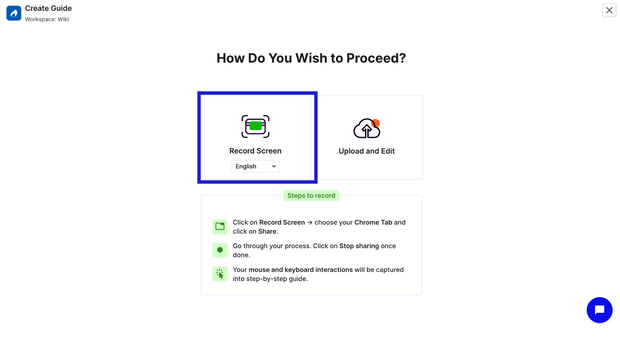
Step 2: Stop recording and Trainn converts into videos or guides
Trainn can convert a recording into an professional-quality instructional video, a step-by-step guide, and an interactive demo each with automatic zooms, spotlights, AI voiceovers and instructions added.
Step 3: Review, edit and publish
Review each clip or step. Add or remove steps, edit the narration through text, adjust zoom and spotlights. When the product changes later, you fix only the affected clip or step, not the whole video or guide.
Step 4: Build the course.
Use the Course Builder to assemble that content (videos, guides, and article) into an interactive course, add quizzes using AI, task to check the learners’ understanding, and attach a certification for the learners who complete it.
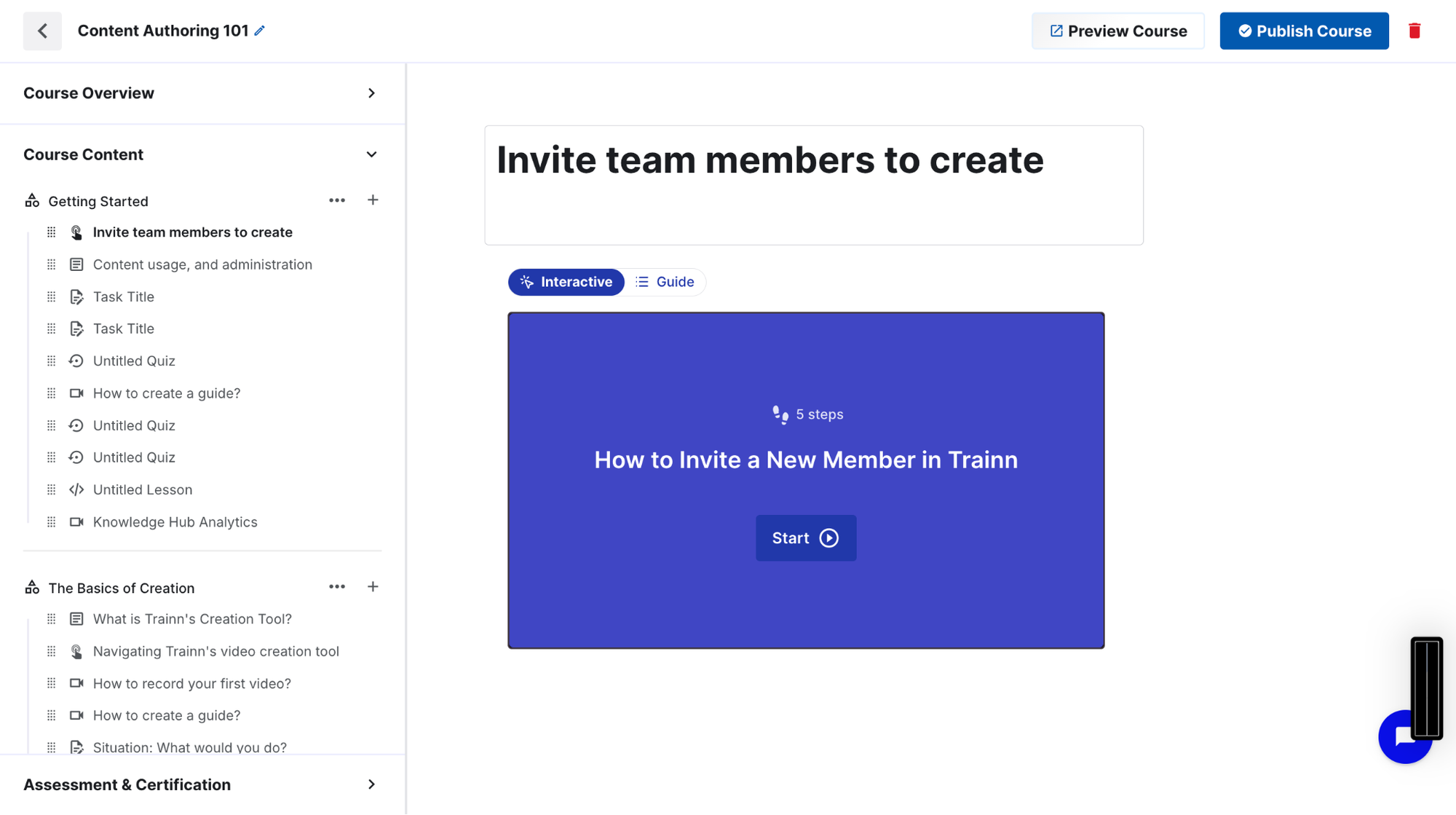
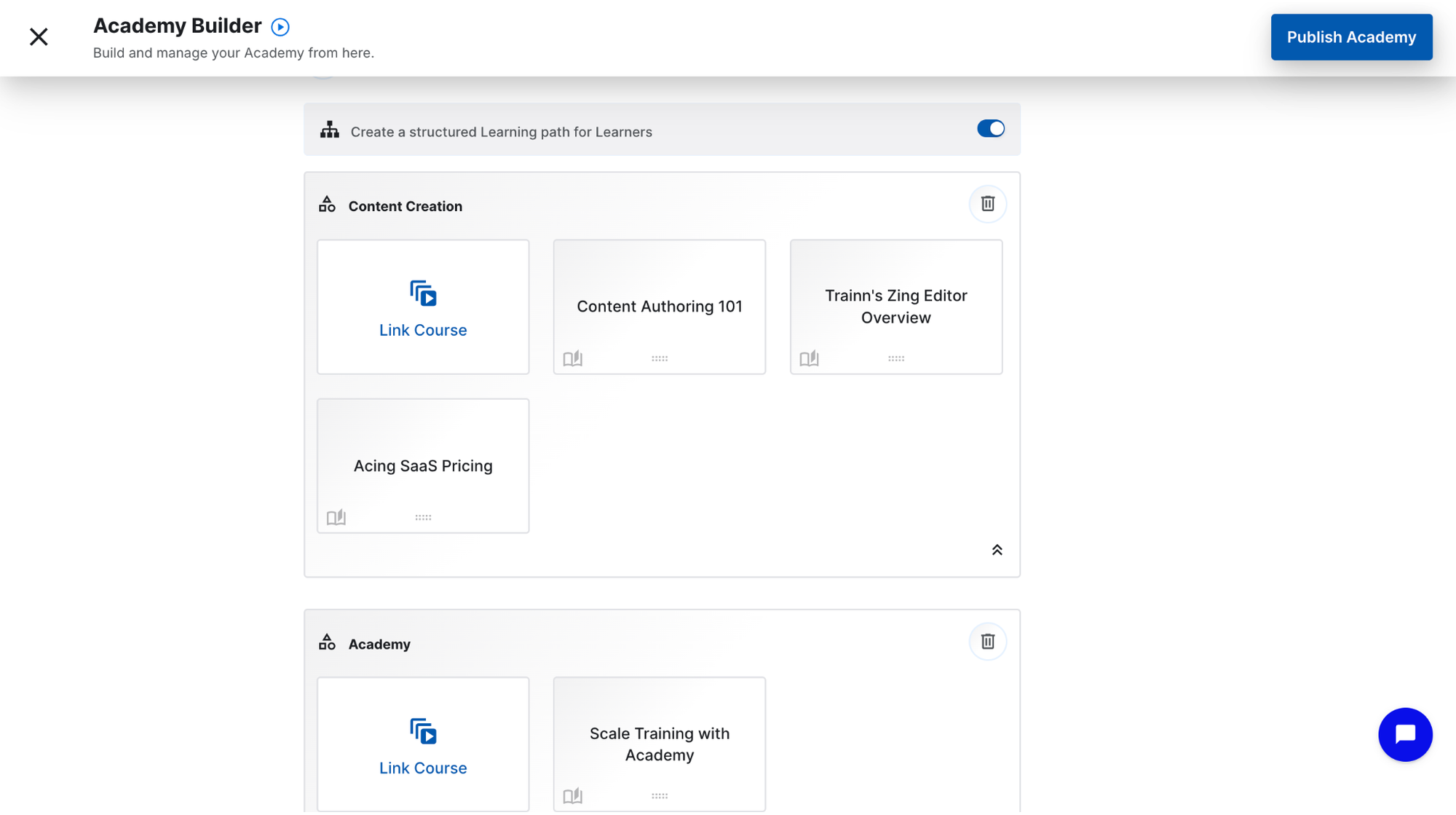
Step 5: Assemble the branded academy.
Use the Academy Builder to publish a fully branded, zero-code academy and organize courses based on each learner's requirements.
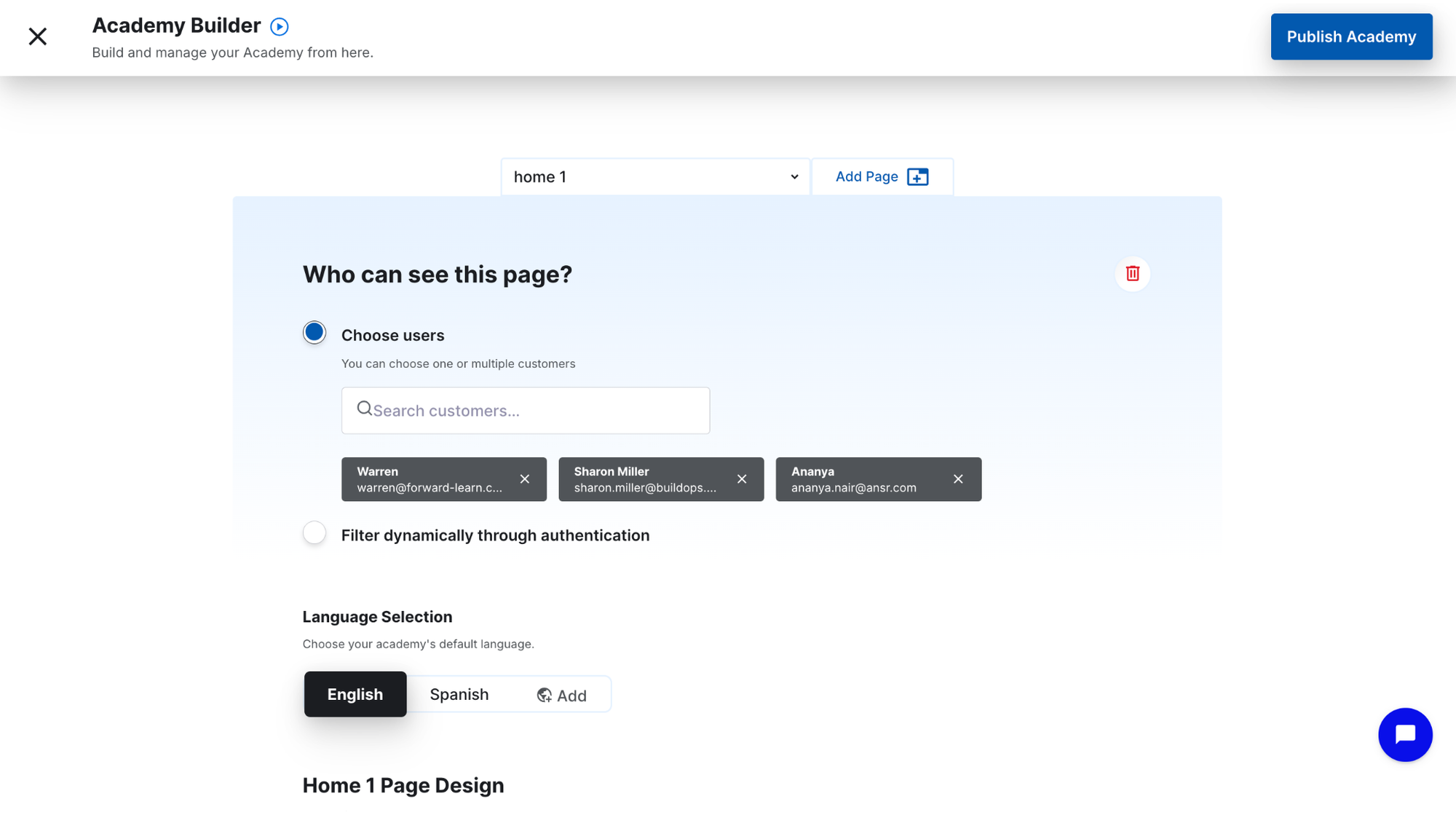
Step 6: Personalize and localize.
Make the academy available in 30+ global languages, and personalize courses based on each learner’s need ( role, email and company ) and deliver the right courses to the right learner.
Step 7: Measure and expand.
Track completion, engagement, and certification analytics from day one, prove the adoption and deflection gains, then add the next path. Enterprise controls (SSO / SAML, GDPR, ISO, SOC 2 Type 2) are built in, so the program scales without a security retrofit.
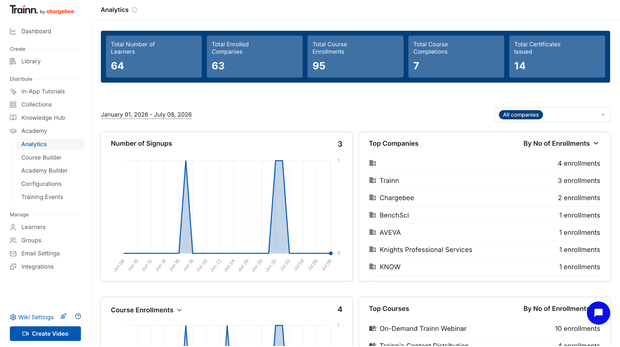
The practical takeaway is that the work that used to require an instructional-design team, a video editor, and a separate LMS now sits behind one platform, which is why a team of one can launch and run a full academy on it.
How AI is Changing Customer Academies in 2026
The biggest shift in 2026 is that AI has collapsed the production cost of a customer academy. Work that used to require an instructional-design team, including scripting, recording, editing, and documenting, can now be produced from a single screen recording. A one-person team can launch an academy that used to need a department.
Three capabilities are driving it. AI content generation turns raw recordings and docs into structured courses. AI tutors answer learner questions against the academy's content around the clock. AI-assisted maintenance and localization keep a growing library current and translated without a proportional increase in effort. The through-line is the same one the 2026 Intellum report captured: 92.6% of programs now use AI in some form, and the teams that adopt it ship more education with less overhead.
The Bottom Line
A customer academy turns repetitive, one-to-one training into a structured resource every customer can self-serve. Start with one onboarding path, give it a clear owner, choose the platform category that fits how your team works, and instrument it from day one so you can prove adoption, deflection, and retention gains. In 2026, AI has made that first launch faster and cheaper than ever, which means the barrier is no longer production, it is deciding to start.
Frequently asked questions
- What is a customer academy?
A customer academy is a branded, self-serve education hub where a company teaches customers how to use its product and succeed with it, through structured courses, learning paths, videos, and certifications.
- What is the difference between a customer academy and an LMS?
An LMS is the software that delivers and manages courses. A customer academy is the branded, customer-facing learning program built on top of it. The LMS is the engine; the academy is the experience.
- How do you build a customer academy?
Define your #1 customer outcome and assign an owner, map and record a single onboarding path, choose a platform, then launch and measure. Most teams ship a first version in weeks and expand from there.
- What is the difference between a customer academy and a knowledge base?
A knowledge base answers "how do I do this one thing?" with quick help articles. An academy teaches structured skills and progress toward mastery or certification.
- How much does a customer academy cost?
It ranges from free course tools to dedicated customer education platforms that start around $300/month. Cost depends on scale, certification needs, in-app delivery, and integrations, not on team size.
- What are examples of customer academies?
Real B2B SaaS academies include Neutrinos Academy (certification-driven, 1,000+ certificates and 70% platform adoption in 9 months), BuildOps Academy (role-based paths, 100+ videos in 45 days), and Groundplan Academy (26 courses and 710 lessons built by a two-person team).
- How do you measure a customer academy's success?
Track completion rate, active learners, time-to-value, product adoption lift, and support ticket deflection, then tie them back to retention and lifetime value.
Trainn is an AI-powered customer education platform that helps B2B SaaS teams build a branded customer academy, from courses and certifications to in-product guidance, in weeks, not quarters. Book a 20-minute demo, and we'll show you how to launch your first learning path.
Ready to Trainn your customers?
- Create videos & guides
- Setup Knowledge Base
- Launch an Academy

Trainn is an AI-powered product video and guide creation platform that turns screen recordings into product demo videos, training videos, onboarding videos, step-by-step guides, and interactive walkthroughs. Trainn also delivers this content externally through a branded no-code LMS, or in-app through embedded tutorials to train customers at scale.

North Bethesda, Maryland 20852


