
- Features
- Resources
- Pricing
- Try Trainn's AI Video Agent


Product
Usecases
Resources
Case Studies
Company
- Customers
- Pricing
- Try Trainn's AI Video Agent
- Expert voices
- Log in
- Book a demo
- Sign up →
Published on: 03 Jun , 2026
8 Best Scribe Alternatives for Customer Training Teams (2026)
On this page
You set up Scribe. You built the guides. You sent the PDFs.
Despite this, the tickets kept coming. Customers still booked calls. They still asked the same questions your guide answered last week, so your team ran the same 30-minute walkthrough for the 200th time.
That's the problem with using a documentation tool for customer training: the guides exist, but customers don't open them. Annotated screenshots are great for your IT team's internal runbooks. They don't help a customer stuck at 4pm trying to figure out your product. Tickets don't drop, time-to-value stretches, and you can't even see whether anyone read the guide you sent.
So we evaluated the 8 tools CS and customer education teams actually switch to, each against one question: can it genuinely train your customers, or does it just help you document for your internal team?
Why Switch From Scribe?
Three specific points make Scribe a poor fit for customer training, and each one surfaces faster than teams expect.
Customers want video, not annotated screenshots. This comes up constantly. Sabina Rana, ex Head of Customer Support at BuildOps, said it plainly: "The team used Scribe to create PDF training guides. But customers always ended up asking for a short video. People are feeling more pressed for time." Annotated screenshots explain what to click. A 90-second video shows how it flows. For most software, that gap matters. (For a practical breakdown of why video works where docs don't, see how to make a tutorial video for customer education →)
There's no place for customers to find your content. Scribe guides live as shared links or downloaded PDFs. They're not in a searchable branded hub. They get sent in an email and then lost. When a customer has a question three weeks into using your product, they don't dig through their inbox; they open a ticket.
You can't see what's working. If 60 customers received your onboarding guide last quarter, how many opened it? Which steps are confusing them? Scribe doesn't tell you. For any CS team trying to improve time-to-value and reduce training calls, that visibility gap is a real problem.
How We Evaluated These Tools
We looked at 8 tools that CS and CE teams most commonly evaluate when searching for Scribe alternatives. For each one, the benchmark is the same: what does it actually do for customer training?
Five things drove the evaluation:
- AI video: Can it also generate a real training video from a screen recording, with narration? Or just annotated screenshots?
- Both interactive walkthroughs and static guides: Can it generate both an interactive guide and a step-by-step static guide from a screen recording?
- Customer-facing hosting: Can your customers find content in a branded, searchable hub, not just a link in an email?
- Learner analytics: Can you see who completed what, where they dropped off, what they searched for?
- LMS/Academy: Is there a structured learning layer to host, organize, and distribute the guides and videos created? Courses, certifications, learning paths?
A tool that covers all five can genuinely replace manual training. A tool that covers one or two is useful for a narrow job, but it's not a full answer.
The Quick Answer: 8 Scribe Alternatives at a Glance
Scribe is built for internal SOPs. The moment your customers start asking for video instead of PDFs, you've hit the ceiling: here are the 8 tools CS and customer education teams actually switch to.
| Tool | Best for | AI video | LMS/Academy | Customer-facing hosting | Analytics |
|---|---|---|---|---|---|
| Trainn | Customer training at scale | ✅ | ✅ | ✅ | ✅ |
| Loom | Async screen recording | ❌ | ❌ | ❌ | ❌ |
| Guidde | AI step-by-step videos | ✅ | ❌ | Limited | ❌ |
| Supademo | Interactive product demos | ❌ | ❌ | Limited | ❌ |
| Clueso | AI-polished screen recordings | ✅ | ❌ | ✅ | ❌ |
| Tango | Annotated step guides | ❌ | ❌ | Limited | ❌ |
| Camtasia | High-production training video | ❌ | ❌ | ❌ | ❌ |
| Trainual | Employee + customer playbooks | ❌ | Limited | Limited | Limited |
The "Customer-facing hosting" and "Analytics" columns tend to be the deciding factor for CS and CE teams. Worth paying attention to before shortlisting.
Prefer to watch? Here's a quick tour of the Scribe alternatives before the full breakdown:

Video transcript
Intro — What Scribe Does
Hi everyone, let's look into 5 best Scribe alternatives that you should be aware of for creating step-by-step guides. Scribe is a step-by-step guide creation tool for internal documentation, and useful to feed AI agents. With the help of Scribe's extension, you can just capture your workflow. After the capture, Scribe creates a step-by-step guide with instructions and annotated screenshots based on your clicks. Here, Guideme helps this guide appear in the actual workflow window to refer and learn, instead of learning from a different window. Scribe is really helpful for creating SOPs and documentation for internal teams.
What a Step-by-Step Guide Tool Should Actually Do in 2026
So the real question isn't only what's exactly like Scribe. It's also, what should a step-by-step guide creation tool actually do in 2026? Number one, the captions that are generated for each step should explain why. As in Scribe's instructions, it just instructs rather than telling the context or explaining why — like "navigate to this" or "just click through this" or "click insert link." But in Trainn's step instruction, it actually explains the context, like "Highlight the text that you want to hyperlink in the email body. Click the insert link, which is at the bottom of your window." Number two: a step-by-step doc on its own just isn't enough anymore to make it engaging. Some customers want to read a document, some want to try a clickable walkthrough at their own pace, and many just want to press play and watch a short video. But Scribe locks you into one format — a step-by-step guide. There's no freedom to create different formats based on what each topic needs and learners' preferences. If you consider Trainn, it lets you create multi-format training content like video, interactive guide, and step-by-step guide, giving flexibility to learn content in the preferred mode. Number three: it's not enough or feasible to just create and stack these guides, or every time share links when asked. Building a searchable hub or academy lets users self-serve, learning whatever they need whenever they need it.
1. Trainn — Complete Customer Education Platform
First up is Trainn. It begins with a Chrome extension. Trainn captures the actions and generates a step-by-step guide, each step with its contextual instructions and annotated screenshots, where zooms and spotlight are applied automatically based on the clicks made. You can fine-tune the guide as per your requirements by editing the screenshot, adjusting the zooms or spotlights, or you can add a CTA onto any step, and more. In Trainn, that single guide actually comes in two modes: an interactive guide and a step-by-step guide. This lets you choose whichever format fits, or let people choose how they'd rather learn. To serve your global audience, you can translate a guide into 30+ global languages with just one click. To keep your guide updated as UI changes, you just have to swap the outdated step with a new UI image, instead of re-recording from scratch. But here's what really sets Trainn apart — it goes way beyond guide creation. Trainn is a complete customer education platform where you can create multi-format training content like videos, interactive guides, and step-by-step guides with zero editing or design experience. Then deliver these contents directly with a built-in knowledge base, or structure them into academy courses, or as an in-app experience, as it's shown here. You can also measure your content performance and see which delivery channel drives more engagement. This helps you iterate your training accordingly.
2. Supademo — Interactive Product Demos
Second alternative is Supademo. Supademo is built for creating an interactive product demo with an AI voiceover. From the Supademo extension, record your workflow, and it generates an interactive walkthrough with clickable hotspots, AI voiceover, and instructions. This lets new customers click and learn each step at their own pace. It helps you embed an interactive demo in your emails and websites, where they can view without signing in. And also, with the help of Demohub, you can group your demos created into a searchable hub for your customers. Supademo is really useful for sales enablement and activating early customers.
3. Tango — Similar to Scribe, More Polished
Number three is Tango. Tango is closely similar to Scribe. Through its extension, it generates a step-by-step guide with a step instruction and an annotated screenshot. It's useful for teams creating internal training. Its output is more polished than Scribe, with a smoother editing experience and stronger formatting.
4. Guidde — Video Slideshow Plus Step-by-Step Docs
Fourth one is Guidde. With the help of the extension, once your workflow is recorded, it generates a video where annotated screenshots are stitched together with an AI voiceover. It's just a slideshow of all steps, but nothing like an engaging video that would help to train your customers. Simultaneously, it also generates a step-by-step guide with annotated screenshots and its instructions. So if you want to create a simple and linear how-to documentation, then Guidde is the best choice.
5. Iorad — Multi-Mode Interactive Tutorials
Last alternative is Iorad. If the workflow is captured, it generates interactive tutorials where users can click through the guide at their own pace. Here, it gives options over different modes, where you can watch this guide as a scroll, as slides, or as a video. Or you can also refer to this guide exactly at your workflow while actually doing it.
Recap and Outro
Here you have it — the top 5 Scribe alternatives on the market today! But remember, capturing a fast step-by-step guide is only step one. The real value comes when you create those resources as engaging content and deliver them through self-serve channels — where your customers can press play, click along, and learn at their own preferred pace. Thanks for watching! Drop a comment with any questions if you have.
1. Trainn by Chargebee (Best for Customer Training at Scale)
Trainn covers the full customer training stack in one place: AI-powered video and guide creation, a self-service Knowledge Hub, a no-code Academy with certifications, contextual in-app tutorials, and learner analytics, without stitching multiple tools together.
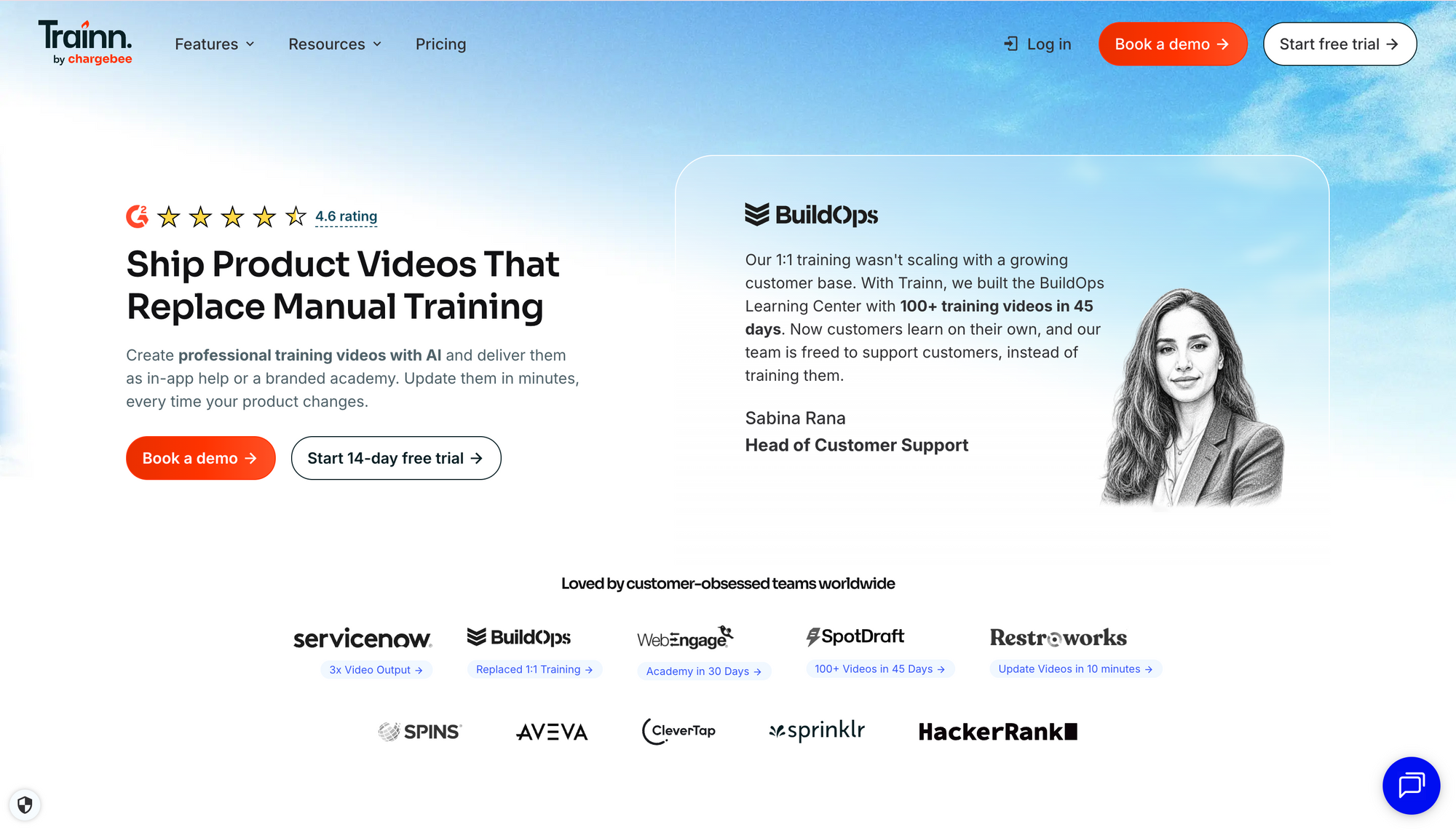
Most tools ask you to pick a format. Trainn doesn't. Record any product workflow once and Trainn automatically generates zooms, voiceovers, and spotlights to produce a training video ready in minutes. That same recording also becomes a scrollable step-by-step guide and an interactive product walkthrough: three formats, one recording, no reformatting.
Trainn best features
AI-Powered Video Creation: Record your screen and Trainn automatically generates zooms, voiceovers, and spotlights. Edit the voiceover as text, not video. Average creation time: 10 minutes per training video.
Knowledge Hub: A no-code, branded, self-service knowledge base your customers can find and search. Takes less than a week to set up. Replace your text-heavy help center with video-first content customers come back to.
Academy (LMS): A no-code customer training Academy with structured courses, quizzes, assessments, and completion certificates. Customers follow a learning path, not a folder of links. Supports SSO, custom domains, and full brand control.
In-App Tutorials: Embed videos and guides contextually inside your product, exactly where users get stuck, without writing a single line of code. Takes 20 seconds to embed. No engineering dependency.
Voiceovers in 30+ Languages: Write your own script or let AI generate one. Translate any video into 30+ languages in one click using ElevenLabs voice integration.
Learner Analytics: Track completion rates, engagement time, search terms, and assessment scores per learner. Know which customers are stuck, which content isn't landing, and where to focus.
Trainn pros and cons
Pros
- Full customer education stack in one platform: video creation, hosting, LMS, in-app tutorials, and analytics
- AI automation cuts video production to ~10 minutes per training video
- Per-customer Collections lets teams package custom content without content duplication
- Knowledge Hub and Academy replace your fragmented Loom + LMS + help center stack
- 30+ language translation with one click
- 14-day free trial on all paid plans
Cons
- Not the right fit if your use case is purely internal employee documentation (Scribe or Trainual handle that better)
- Setup investment is higher than a single-use tool like Loom or Guidde; this is a platform, not a recorder
Trainn pricing
14-day free trial, then tiered paid plans starts at $19. See trainn.co/pricing for current plans.
Trainn ratings and reviews
- G2: 4.8/5
- Capterra: 4.8/5
See Trainn in action. The fastest way to see if Trainn fits your team's workflow is a 20-minute walkthrough. We'll show you how other CS teams set up their Learning Center, tailor the demo to your stack, and answer the "what about our existing Scribe guides?" question live.
Book a demo → | Start a 14-day free trial →
📖 Also Read: How CS teams scale customer training with Trainn
2. Loom (Best for Async Screen Recording, Not for Structured Training)
Loom is the fastest way to record and share a screen walkthrough. But it has no academy, no completion tracking, and no structured learning layer. It's a video tool, not an education platform.
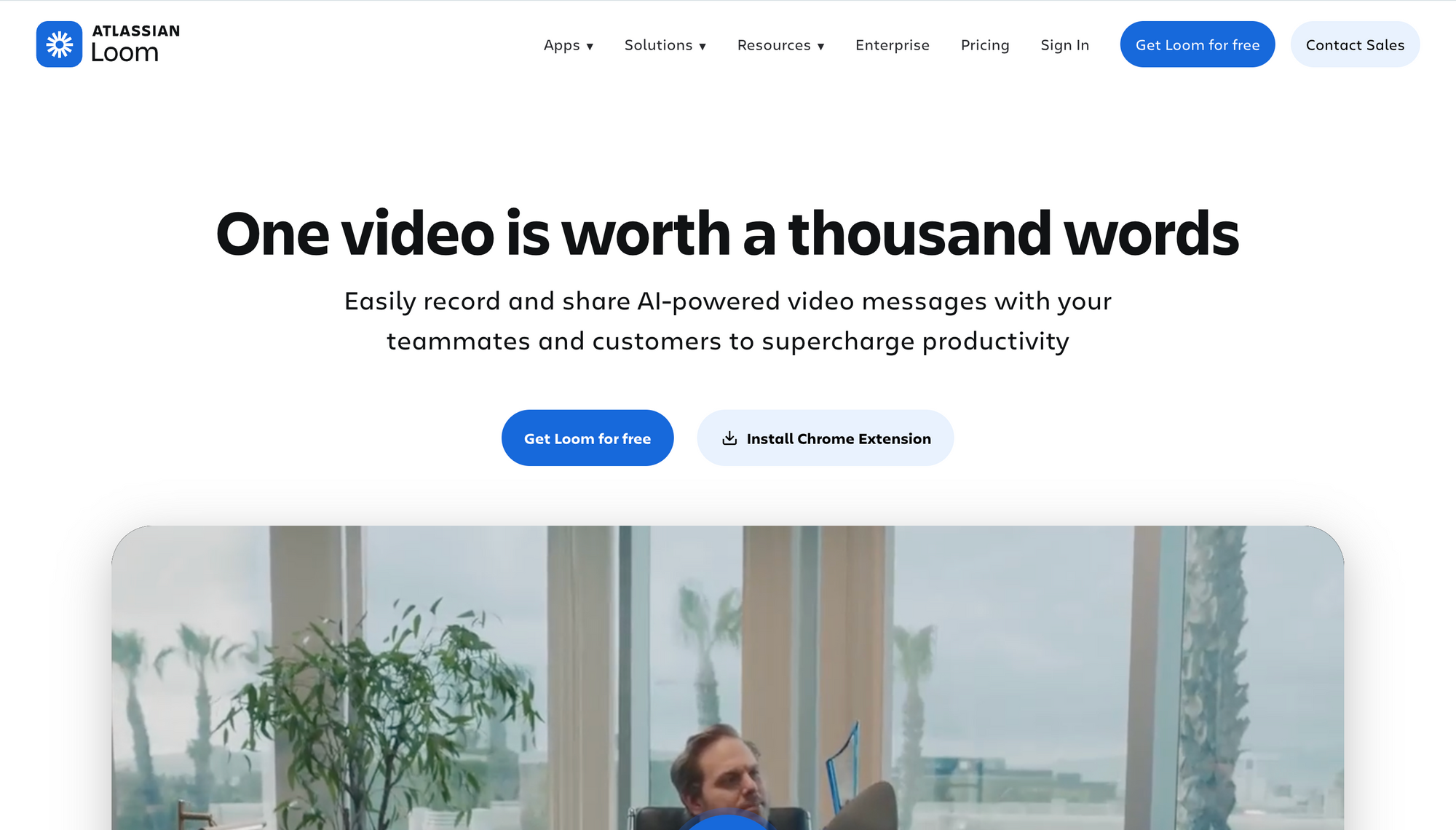
Speed is the headline feature. Record a walkthrough, share a link in under two minutes, no editing required. Most SaaS teams already have Loom accounts, so there's no friction on the receiving end. For quick internal async communication (a team update, a one-off product walkthrough, an informal explanation), it's hard to beat.
Loom best features
- One-click screen + camera recording, shareable as a link in under two minutes
- Viewer reactions and comments on the video timeline
- AI-generated captions and summaries
- Basic view count analytics per video
- Integrates natively with Slack, Notion, and most SaaS tools
Loom pros and cons
Pros
- Fastest path from recording to shared link, no editing, no upload friction
- Everyone already has a Loom account, so customers can watch without creating one
- Good for quick one-off walkthroughs and internal async communication
- Free tier available for individuals
Cons
- No LMS, no structured courses, no certifications, no completion tracking
- Videos live on Loom's domain, no branded hub for customers to return to
- No organized learning paths, no searchable library customers can browse
- When your product updates, every video is a manual re-record with no shortcuts
- Zero visibility into whether customers actually completed your training
Loom pricing
- Starter: Free (up to 25 videos, 5-min limit per video)
- Business: $15/user/month
- Business + AI: $20/user/month
- Enterprise: Contact sales
Loom ratings and reviews
- G2: 4.7/5
- Capterra: 4.7/5
📖 Also Read: Trainn vs. video tools - how CS teams choose
Also compare: Loom vs Scribe
3. Guidde (Best for Quick AI Step-by-Step Videos)
Guidde auto-generates AI-narrated walkthroughs fast and has improved meaningfully since 2023, but it's content creation only. No LMS, no academy, no structured learning paths, just a video out the other end.
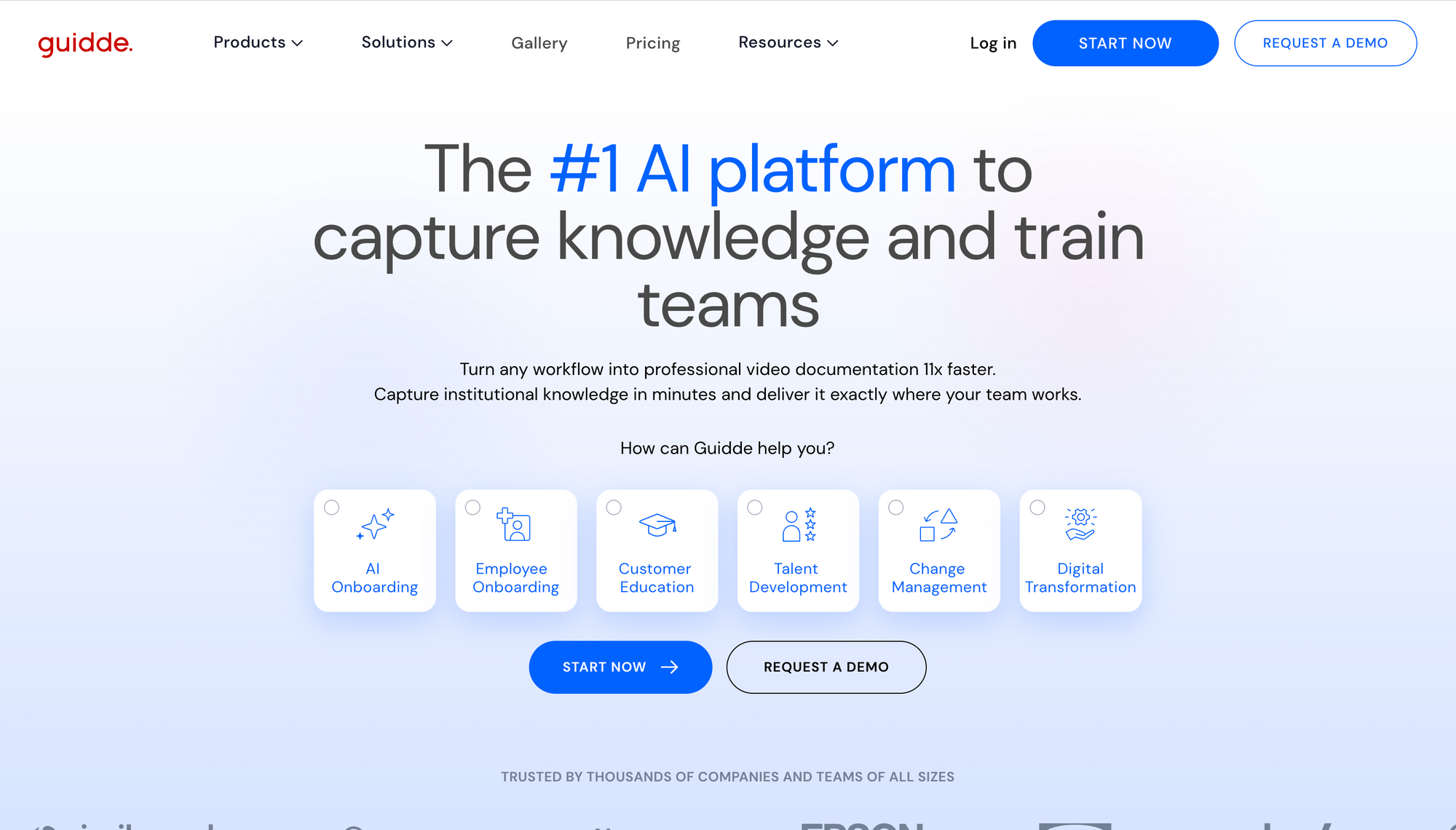
The browser extension captures a workflow and produces AI-narrated step-by-step videos without manual editing. It's fast, and the output is genuinely good for straightforward, linear product flows. Teams evaluating tools in this space often shortlist it alongside Clueso: "We like products like Guidde and Clueso that can record the screen and then use AI to automatically break down the workflow into steps that can be easily edited in the browser editor," said a CS team lead during a Trainn demo call.
Guidde best features
- Browser extension captures workflows and generates AI-narrated step-by-step videos automatically
- AI voiceover with multiple voice options
- One-click sharing as a video or embeddable link
- Basic embed capability for help centers and wikis
- Free tier with limited video count
Guidde pros and cons
Pros
- Fastest AI video generation for straightforward, linear product flows
- No editing skills required: the AI does the narration and step breakdown
- Free tier makes it accessible for small teams testing the workflow
- Output is genuinely good for simple, linear walkthroughs
Cons
- Content creation only: no hosting hub, no LMS, no certifications, no learner analytics
- Struggles with complex UI or non-standard product fields: "We tried Guidde but it's not good for us because it's not recognizing all the fields in our tool. It doesn't put the shape in the right place," said Orit at Onit
- No structured courses or learning paths: you can share a link, but you can't build an education program
- Limited analytics: no completion data per learner
Guidde pricing
- Free: Limited videos and features
- Pro: Paid plans available, starting at $19 per creator / month
- Enterprise: Contact sales
Guidde ratings and reviews
- G2: 4.5/5
- Capterra: 4.5/5
📖 Also Read: Trainn vs. AI video tools - what's the difference?
Also compare: Guidde vs Scribe
4. Supademo (Best for Interactive Product Demos)
Supademo is excellent for clickable product demos during sales and onboarding, but it's demo-first, not education-first. No completion tracking, no certifications, no academy.
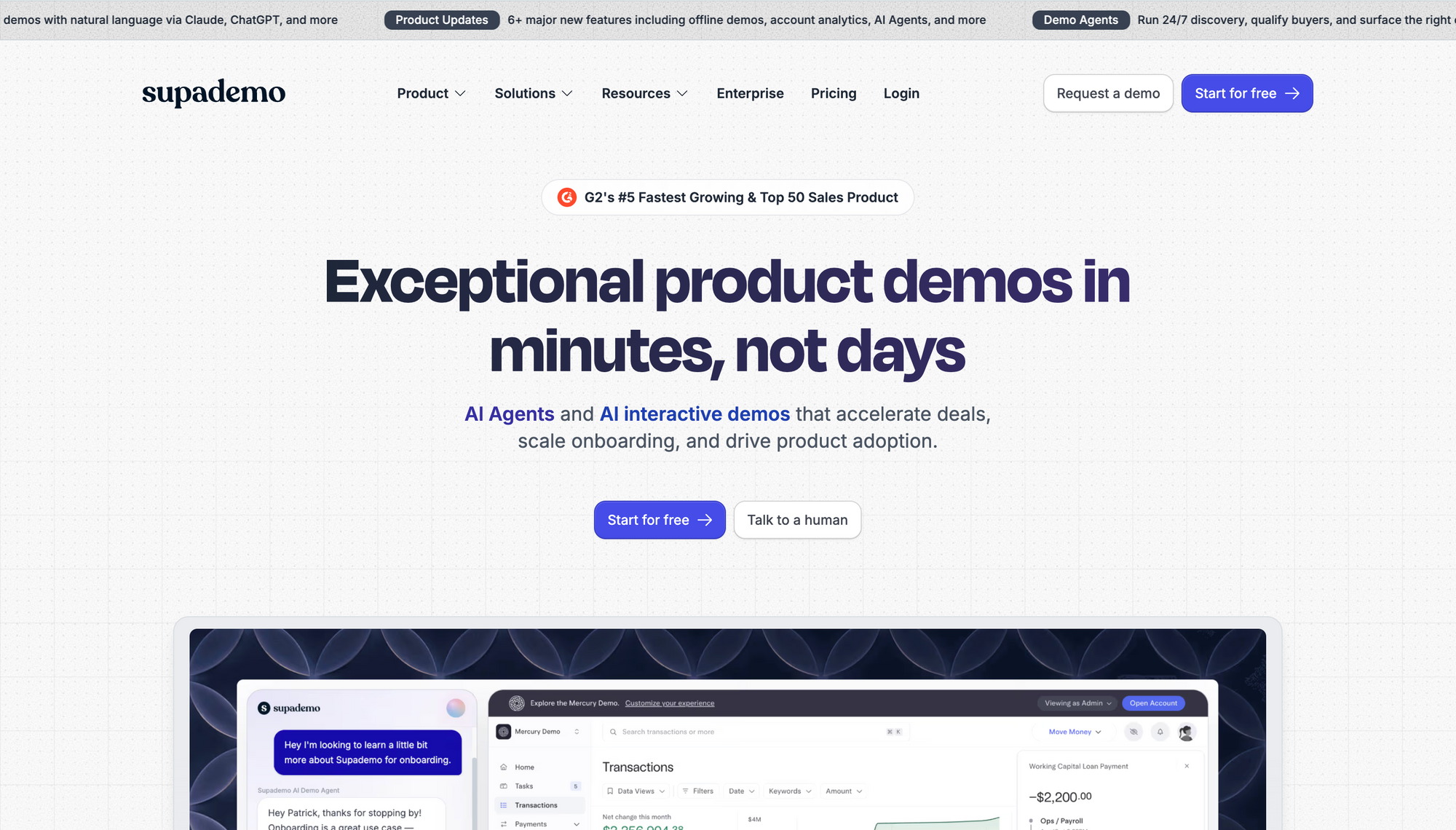
Supademo builds interactive, screenshot-based product tours that prospects and new customers can click through at their own pace. It's clean, fast to build, and easy to embed in an email or on your website. For letting a prospect explore your product before a discovery call, or giving a new customer an interactive first look, it works well.
Supademo best features
- Screenshot-based interactive product tours with clickable hotspots
- Embed in emails, websites, and help centers without a login
- Custom branding and domain options
- Basic analytics on demo views and engagement
- Fast build time: most demos take under 20 minutes to produce
Supademo pros and cons
Pros
- Excellent for top-of-funnel demos and early product activation
- No login required for viewers, frictionless for prospects
- Easy to embed anywhere and update without re-sending
- Clean, professional output that works well in outbound sales sequences
Cons
- Screenshot-based, not video: no narration, no motion-based learning
- No LMS layer for structured education, no completion certificates
- Demo-oriented analytics (views, clicks), not learner-level training analytics
- Not a standalone training platform; needs a dedicated training tool alongside it
Supademo pricing
- Free: Limited demos
- Pro: ~$27/user/month
- Scale: Custom pricing
- Enterprise: Contact sales
Supademo ratings and reviews
- G2: 4.7/5
- Capterra: 4.8/5
Also compare: Scribe vs Supademo
5. Clueso (Best for AI-Polished Screen Recordings)
Clueso takes raw screen recordings and adds AI editing, captions, and polish, but it has no hosting, no academy, and no structured education layer. It's a production step, not a platform.
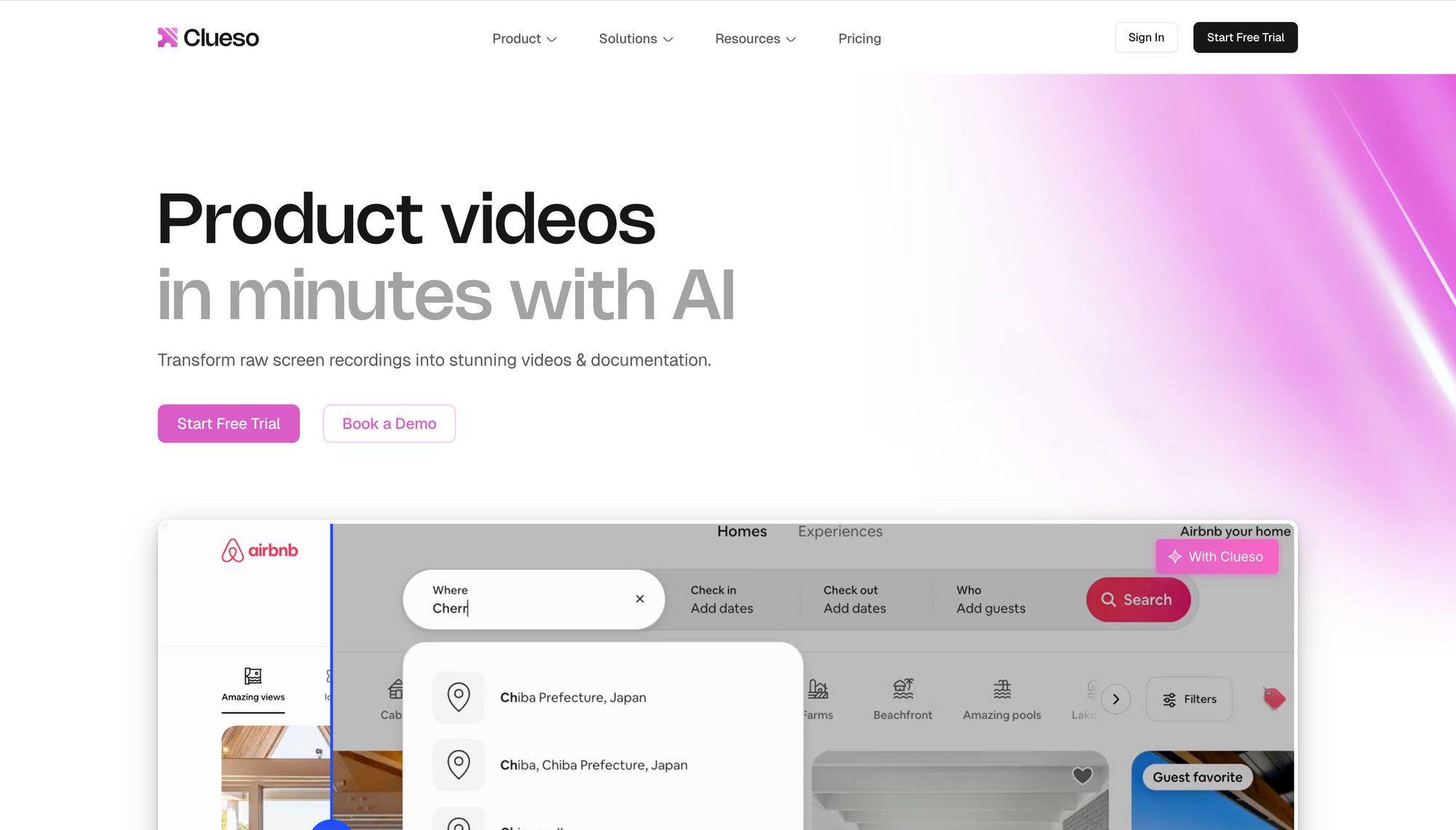
If your team has a backlog of raw Loom recordings and wants to make them customer-presentable without a video editor, Clueso is the answer. It removes filler words, adds zooms and highlights automatically, and cleans up the pacing. A messy 8-minute screen recording becomes a watchable 4-minute tutorial without re-recording anything.
Clueso best features
- AI filler-word removal and pacing cleanup
- Automatic zoom-ins and highlight effects
- Captions generated automatically
- Chapter markers and structured output
- Works from existing Loom recordings, no re-record required
Clueso pros and cons
Pros
- Dramatically reduces post-production time for teams with raw recording backlogs
- Good output quality without a professional video editor
- Works from recordings you already have, zero re-recording needed
- Useful as a production step inside a larger training stack
Cons
- No hosting hub: the polished video still needs a home
- No LMS, no certifications, no learner-level analytics
- If you're looking for an end-to-end training solution, you'd still need to assemble the rest of the stack separately
- Pricing starts at $120+/month, high for a tool that covers only one part of the workflow
Clueso pricing
- Starts at ~$120/month
- Higher tiers available: contact Clueso for current pricing
- Enterprise: Contact sales
Clueso ratings and reviews
- G2: 4.5/5
- Capterra: 4.5/5
📖 Also Read: Trainn vs. AI video creation tools - which covers the full workflow?
Also compare: Clueso vs Scribe
6. Tango (Best for Annotated Step Guides, Same Category as Scribe)
Tango is polished and faster than Scribe for annotated step guides, but it's the same tool category. If you're searching for a Scribe alternative because customers aren't engaging with your guides, Tango solves the workflow pain but not the format problem.
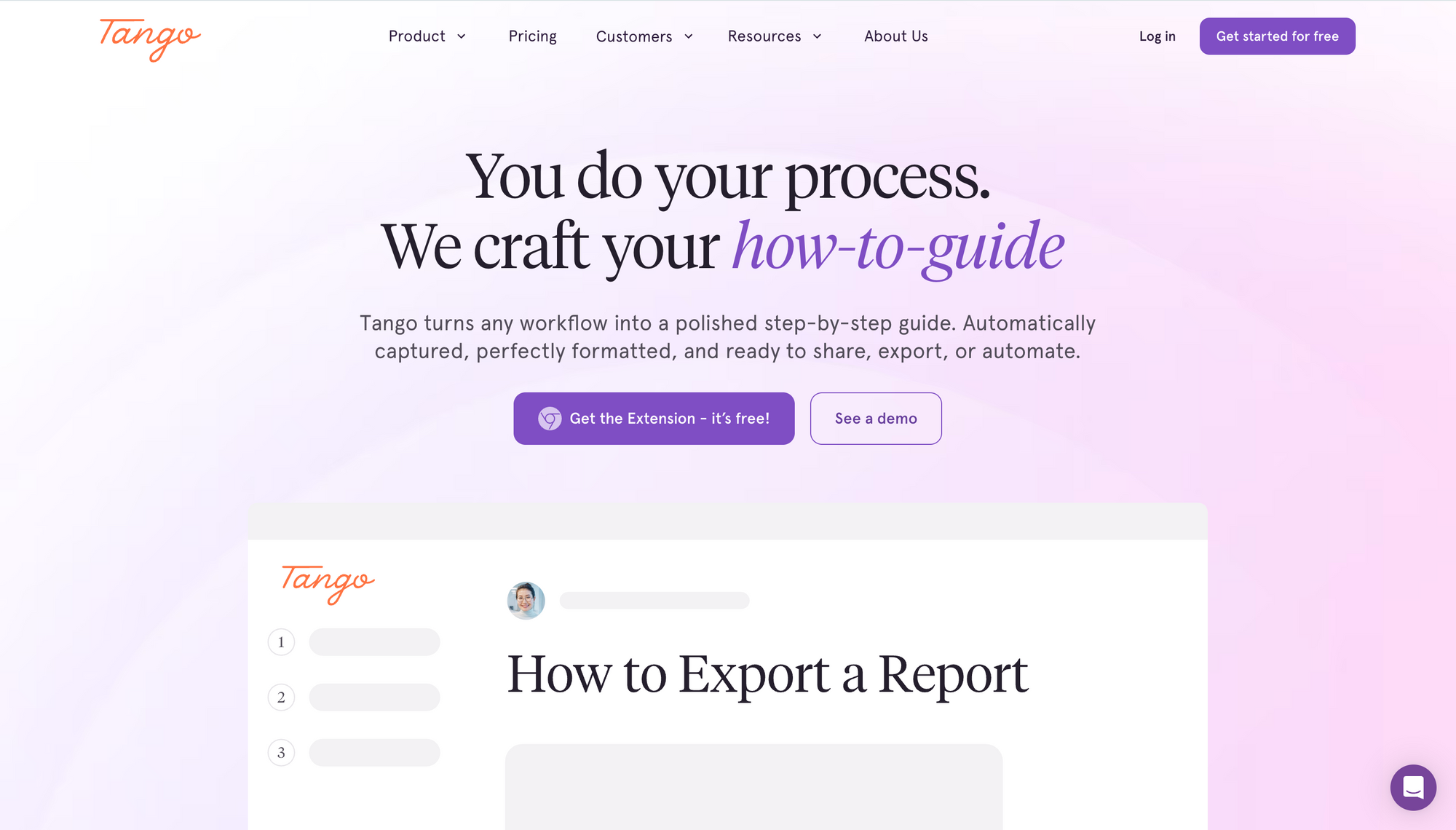
The browser extension captures workflows with cleaner, better-formatted annotated screenshots than Scribe. Formatting controls are stronger, outputs look more professional, and the editing experience is smoother. For internal SOPs, IT documentation, and help center articles aimed at employees, it's a genuine step up from Scribe.
Tango best features
- Browser extension captures click sequences and auto-annotates screenshots
- Cleaner, more polished output than Scribe with better formatting controls
- One-click sharing as a link or embeddable in a knowledge base
- Enterprise knowledge base with access controls
- Integrates with Notion, Confluence, and other wikis
Tango pros and cons
Pros
- Noticeably more polished output than Scribe: better formatting, cleaner annotations
- Fast capture: works in the browser, no desktop app required
- Good fit for internal SOPs, IT documentation, and employee-facing knowledge bases
- Reasonable enterprise pricing if you're already running guides-based documentation
Cons
- Guide and document output only: no video, no narration, no motion
- No completion tracking, no LMS, no certifications
- Same fundamental gap as Scribe for customer training: customers want to watch, not read
- Switching from Scribe to Tango is a lateral move in document quality, not a step forward for reducing live training calls
Tango pricing
- Free: Basic features, limited guides
- Pro: Available for individuals and small teams
- Enterprise: ~$22/user/month. Contact sales for full pricing
Tango ratings and reviews
- G2: 4.8/5
- Capterra: 4.7/5
📖 Also Read: Trainn vs. guide-creation tools: when annotated guides aren't enough
Also compare: Scribe vs Tango
7. Camtasia (Best for High-Production Training Video)
Camtasia gives instructional designers full control over professional-grade video output, but it has no AI narration, no auto-generation, and no hosting. It's a production tool with no platform layer attached.
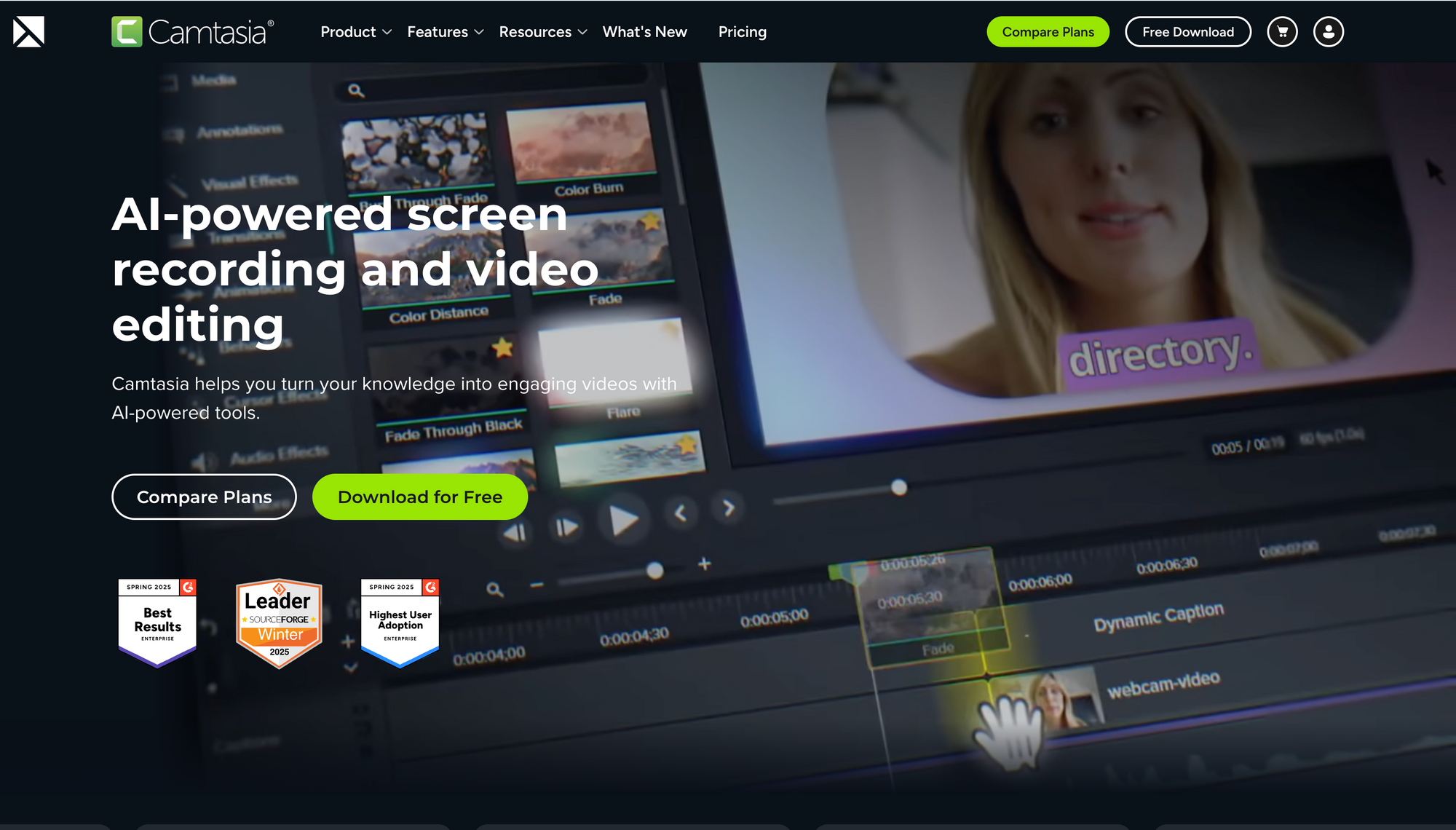
The output quality ceiling is the highest of anything on this list. Full timeline editing, multi-track audio, custom animations, call-outs, zoom effects. It's the industry standard for instructional design teams that need broadcast-quality video. It exports to any format and integrates with whatever hosting you choose.
Camtasia best features
- Full timeline video editor with multi-track audio and effects
- Custom animations, callouts, zoom-and-pan, and transitions
- Screen + webcam recording with frame-level editing control
- Exports to MP4, GIF, and other formats for any hosting platform
- One-time license purchase option (not subscription-only)
Camtasia pros and cons
Pros
- Highest output quality ceiling on this list: broadcast-level video production
- Full editing control, every frame
- Works with any hosting platform, no vendor lock-in on distribution
- One-time license available if you prefer not to pay annually
Cons
- Full production workflow required per video: record → voiceover → edit timeline → export → upload → organize in LMS
- No AI acceleration: every video is manual, every update is a full re-edit
- When your product changes and 20 tutorials need refreshing, that's 20 individual editing sessions
- No hosting, no LMS, no analytics: you're assembling a four-to-five tool stack
- Teams consistently describe this stack as "3x the time it should take"
Camtasia pricing
- Subscription: ~$179/year per user
- Perpetual license: One-time purchase available (check current pricing at TechSmith.com)
- Enterprise: Contact sales
Camtasia ratings and reviews
- G2: 4.5/5
- Capterra: 4.6/5
📖 Also Read: Trainn vs. traditional LMS: what CS teams actually need
Also compare: Scribe vs Camtasia
8. Trainual (Best for Structured Employee and Customer Playbooks)
Trainual is a training and onboarding platform built primarily for internal employee training, but it's frequently evaluated alongside Scribe by CS teams looking for more structure. Think of it as a step up from Scribe in terms of sequencing (you get courses, quizzes, and tracking), but still anchored in the internal team use case rather than scaled customer education.
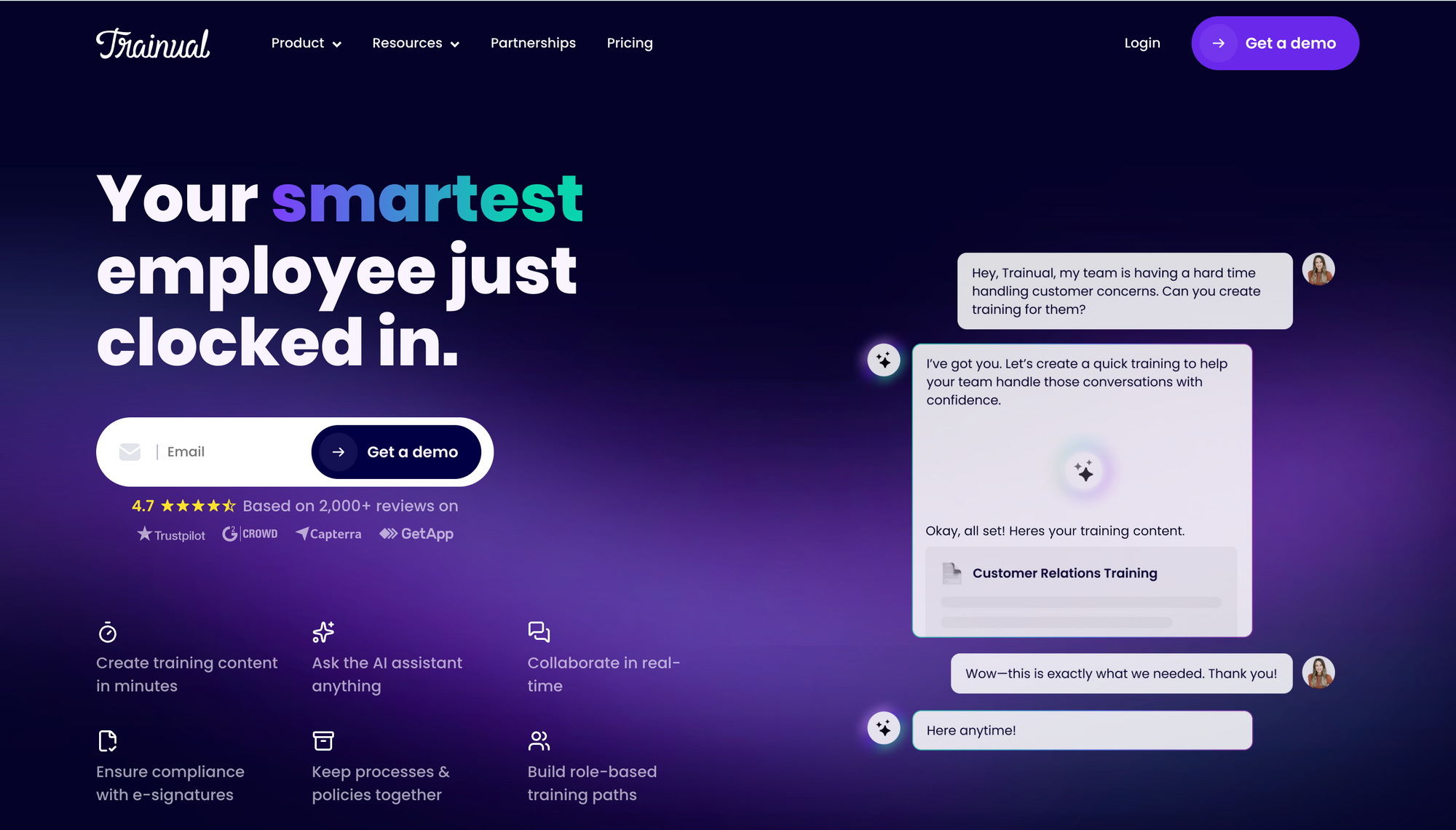
If your Scribe problem is "our guides have no structure and employees skip steps," Trainual solves that well. If your problem is "our customers aren't engaging and our support call volume is still high," Trainual doesn't move the needle where it counts.
Trainual best features
- Course and playbook builder with structured sequences and role-based paths
- Quizzes and assessments to verify understanding and track completion
- Progress tracking and completion data across your team
- Role-based training assignments, different tracks for different job types
- Integrations with Gusto, Rippling, Slack, and other HR and team tools
Trainual pros and cons
Pros
- Better structure than Scribe for sequenced training: courses flow, not just linked docs
- Completion tracking and quiz results give you visibility into whether training landed
- Works for both employee onboarding and basic customer training in one platform
- Clean UX and onboarding experience: teams find it quick to set up
Cons
- Built for employees, not customers: limited customer-facing branding and white-labeling
- No AI video generation: content is still text and screen recording, not polished video
- No per-customer content packaging (no Collections-equivalent)
- Analytics are basic for customer education use cases, completion data but not engagement depth
- Pricing escalates quickly for larger teams; not cost-effective at scale compared to a purpose-built CE platform
- Customer-facing academy experience is limited compared to tools built explicitly for external learners
Trainual pricing
- Starts at ~$249/month for up to 10 users
- Higher-tier plans scale with user count and features
- Enterprise: Contact sales
Trainual ratings and reviews
- G2: 4.7/5
- Capterra: 4.8/5
📖 Also Read: Trainn vs. traditional LMS: what CS teams actually need
When Scribe Still Makes Sense
Scribe still earns its place for internal SOPs and team runbooks, quick step capture, easy to share inside the company. The gap shows up the moment your audience becomes your customers rather than your colleagues.
Why Companies Switch Away from Scribe (A Real Example)
BuildOps tried the Scribe → PDF approach for customer training. Their customers kept asking for video anyway. This is the pattern.
BuildOps is a field service management platform. Their CS team used Scribe to create PDF training guides for customers. The guides were thorough. They covered the right workflows. They went out to every new customer.
Sabina Rana, their Head of Customer Support, kept noticing the same thing: customers hadn't read them.
"The team used Scribe to create PDF training guides. But customers always ended up asking for a short video. People are feeling more pressed for time. Most customers love those quick 1-minute videos to learn the product."
Sabina Rana, Head of Customer Support, BuildOps
That gap (guides produced, guides ignored, support calls unchanged) is exactly what CS teams describe when they explain why they started searching for alternatives. The documentation effort was real. The customer behavior didn't follow.
After switching to Trainn, BuildOps built the BuildOps Learning Center with 100+ training videos in 45 days. Customers now self-serve 24/7. The implementation and CS team stepped off the repetitive training call treadmill and redirected that time into work that actually moves customer outcomes.
They're not the only ones. WebEngage launched their Academy with 75 videos in 4 weeks using Trainn. ServiceNow now produces 15–20 training videos per week. The pattern is the same: documentation tool → PDF no one reads → switch to a platform built for video-first customer education.
The BuildOps situation isn't unusual. It's the default outcome when a customer training program is built on a document tool. Customers are time-pressed, they're often on mobile, and a multi-page annotated PDF is not what they want when they're stuck on a workflow at 4pm. They want a 90-second video that shows them exactly what to do. A documentation tool helps you produce a guide. A training platform changes how customers learn.
How to Choose the Right Scribe Alternative
One question decides 90% of this: are you training customers, or documenting for internal teams?
| If your goal is to… | …then use: |
|---|---|
| Build a customer training program with video, interactive walkthroughs, static guides, courses, certifications, a hosted academy, and analytics | Trainn: the only tool here that covers all five requirements without stitching tools together. See how CS teams scale customer training → |
| Send quick async video for internal or onboarding comms (no formal academy) | Loom or Guidde: fast, lightweight, no setup. Won't scale once you need structure. |
| Build sales demos and interactive onboarding flows customers click through before a live call | Supademo for the interactive demo layer; pair with a customer onboarding platform for ongoing education. |
| Just get better annotated step guides for internal docs | Tango: cleaner output than Scribe. But if your real problem is customers not reading guides, Tango makes better-looking guides they still won't read. |
Can I Migrate My Scribe Guides to Trainn?
The biggest bottleneck to switching software isn't pricing or learning curves; it’s the dread of migration. When your team has spent months capturing workflows, formatting steps, and building out a library of 50+ Scribe guides, the idea of starting over from scratch feels impossible.
You don’t have to.
The transition from internal documentation to scaled customer education doesn't mean burning down your existing work. Here is exactly how migration works when moving from Scribe to an all-in-one platform like Trainn:
-
No-Loss PDF Ingestion: Scribe allows you to export your guides as PDFs or Markdown files. Trainn supports the direct migration and hosting of these existing files. You can upload your legacy text-and-screenshot manuals straight into your new branded Knowledge Hub on day one.
-
Centralizing Your Loom Backlog: If your Customer Success team has been patching over Scribe’s formatting gaps by dropping loose Loom links into emails, you can bulk-import those video assets into Trainn too. This instantly gives your messy video files a structured, searchable home.
-
The "Phased Fresh-Start" Strategy: You do not need to convert every document into an AI-narrated video overnight (p. 15). Most switching teams keep their legacy Scribe PDFs active in Trainn's Hub for secondary features, while using Trainn’s 10-minute automated video creator to record their high-impact, high-ticket core onboarding workflows first.
Migration shouldn’t hold your customer training program hostage. You can move your existing documentation over to Trainn in under a week, keeping your current support resources live while you upgrade to a video-first academy experience.
Frequently Asked Questions
Is Scribe good for customer training?
Scribe is built for internal documentation. For customer training, it's missing video generation, a customer-facing hosting layer, completion tracking, certifications, and learner analytics. Most CS teams that start using Scribe for customer training end up looking for alternatives once the scale pressure hits.
What's the best Scribe alternative for CS teams?
For CS teams specifically (those trying to scale customer onboarding, reduce live training calls, and build a self-serve learning experience), Trainn covers the full requirement. It's the only tool on this list with AI-powered video creation, a branded Knowledge Hub, an LMS with certifications, per-customer Collections, and learner analytics all in one platform.
What did teams use before Trainn?
The most common stack before Trainn: Loom for recording, Vimeo or YouTube for hosting, and a separate LMS. Sometimes Scribe or Tango for written guides. Camtasia for teams with production capacity. Trainn replaces the whole stack: one subscription, one login, one analytics dashboard.
What's the difference between Trainn and Guidde?
Both generate AI-narrated video guides from screen recordings. The difference is what happens after creation: Guidde produces a video you share via link. Trainn produces a video, an interactive guide, and a documentation article, then hosts all three in a searchable Knowledge Hub or Academy with learner tracking and certifications. Content creation tool vs. full education platform.
Does Trainn replace an LMS?
For most B2B SaaS customer training use cases, yes. Trainn has structured courses, quizzes, assessments, certifications, and learner-level analytics, the core LMS features CS and CE teams need. The exception is compliance-heavy internal training with SCORM/xAPI audit requirements; for that specific use case, a dedicated compliance LMS may still be needed.
See how Trainn replaces Scribe for customer training: book a demo
Ready to Trainn your customers?
- Create videos & guides
- Setup Knowledge Base
- Launch an Academy

Trainn is an AI-powered product video and guide creation platform that turns screen recordings into product demo videos, training videos, onboarding videos, step-by-step guides, and interactive walkthroughs. Trainn also delivers this content externally through a branded no-code LMS, or in-app through embedded tutorials to train customers at scale.

North Bethesda, Maryland 20852


