
- Features
- Resources
- Pricing
- Try Trainn's AI Video Agent


Product
Usecases
Resources
Case Studies
Company
- Customers
- Pricing
- Try Trainn's AI Video Agent
- Expert voices
- Log in
- Book a demo
- Sign up
AI Knowledge Base: Create Smarter Help Content in Minutes
Trainn turns screen recordings into help videos and guides, then powers your knowledge base with AI search that understands what customers are actually asking, with translation into any language. No developer, no design skills.
Why an AI Knowledge Base Matters
Customers find answers even with a vague search
A traditional knowledge base only works if the customer already knows the right words to search. An AI knowledge base understands intent rather than exact keyword matches, so a customer typing a vague, half-formed question still lands on the right article — and fewer customers give up on search and open a ticket instead.
Onboarding search stays useful during a stressful first week
A CS team can point customers to an AI-powered knowledge base with more confidence during onboarding, knowing that even an imprecise search query still surfaces something useful. New customers rarely know the exact terminology yet, which is exactly when intent-based search matters most.
Content reaches the right partners without manual tagging
A product team shipping frequent releases benefits from an AI knowledge base's ability to recommend related content automatically, surfacing a newly published article to the right customers or partners without anyone manually tagging or promoting it. The effect compounds — an AI knowledge base gets more useful as more content is added, both because there's more to search and because recommendation improves with a larger library to draw from.
Why an AI Knowledge Base Is Better Than a Traditional One
It understands questions, not just keywords
A traditional knowledge base search matches the words a customer typed against the words in an article's title or body — miss the exact phrasing, and the customer gets nothing useful. An AI knowledge base search understands intent and context, so a customer asking a question in their own words still finds the right answer.
It creates the content that goes into it
Most knowledge base tools assume the content already exists somewhere and just need a place to host it. Trainn's AI knowledge base generates the help videos and guides it hosts, directly from screen recordings — closing the gap between "we have a knowledge base" and "our knowledge base actually has useful content in it."
It recommends the right content automatically
A traditional knowledge base relies on a customer finding the right article through search or browsing a category list. An AI knowledge base can surface relevant content proactively based on what a customer is doing or asking, without a human curating recommendations by hand.
What Is an AI Knowledge Base?
An AI knowledge base is a self-service help center that uses AI — for search, content recommendations, and often content creation — rather than relying purely on keyword-matching and manual curation. Trainn — an AI-powered product video and guide creation platform — pairs AI-powered search that understands user intent with the ability to generate the help content the knowledge base runs on directly from screen recordings, so the "AI" in AI knowledge base covers both how customers find answers and how those answers get created in the first place. Trainn's AI knowledge base can go from a screen recording to a published, searchable article in under 5 minutes, with translation into any language.
How to Choose an AI Knowledge Base
AI knowledge base tools differ mainly on three things: whether "AI" means smarter search, AI-assisted writing, or both; whether the tool creates the underlying content or only organizes content written elsewhere; and how deep the personalization and segmentation options run for different customer segments.
| Tool | How It Creates | Output Formats | Hosts & Delivers Content | Languages | Best For |
|---|---|---|---|---|---|
| Trainn | Screen recording, analyzed automatically | Help videos, step-by-step guides, articles | Yes — public or private hub with AI search, SSO/SAML | Translate into any language | SaaS support and CS teams that need AI-powered search plus AI-generated help videos and guides in one system — without a developer, designer, or writing team |
| Document360 | Manual article authoring; AI Search, AI writing agent, AI chatbot | Written articles, with video support | Yes — enterprise-grade hub, SSO/SCIM | Machine translation for articles | Enterprise teams wanting a mature AI search and chatbot layer over a large, primarily text-based article library |
| ProProfs Knowledge Base | Manual authoring, AI Writer for drafting | Written articles and multimedia embeds | Yes — hosted hub, AI-powered search | 70+ languages, text-focused | Teams that want AI-assisted drafting and search on top of a simple, affordable text-based help center |
| Guru | Manual authoring, AI Ask for verified answers | Written cards and verified answers | Yes — internal-first, Slack/browser integration | English-focused | Internal teams needing AI-verified answers surfaced in Slack and the browser, rather than a customer-facing help center |
| Intercom | Manual authoring plus AI-generated draft suggestions from tickets | Written articles integrated with live chat/AI agent | Yes — hosted hub tied to support inbox | Multi-language support for articles | Support teams that want AI knowledge base content tied directly into a live chat and AI support agent workflow |
| Zendesk Guide | Manual authoring with AI-suggested articles | Written articles, integrated with ticketing | Yes — hosted hub tied to Zendesk ticketing | Multi-language support for articles | Teams already standardized on Zendesk who want AI article suggestions inside their existing support stack |
How to decide: If your priority is AI search and a chatbot over an existing large enterprise article library, Document360 fits. If your knowledge base needs to live inside your existing support ticketing workflow, Intercom or Zendesk Guide work well. If you need AI-generated help videos and guides feeding an AI-searchable knowledge base — without hiring a separate content team — Trainn covers content creation and intelligent search together.
How to Build an AI Knowledge Base with Trainn
Record
Turn on the Trainn Chrome extension and record the workflow you want to document. Trainn's AI video agent turns the recording into a help video or step-by-step guide automatically.
Edit
Set your knowledge base to public or private, with SSO and SAML support, and apply your logo, colors, and a custom domain.
Publish/Share
Launch the in-app Help Widget so customers get AI-powered, contextual answers without leaving your product, and 24/7 without a support agent needing to be online.
Use Trainn's AI Knowledge Base to Create Help Content
Record Your Screen
Record the workflow you're documenting; the AI video agent understands what you're teaching and handles the rest.
AI-Generated Step-by-Step Guide
It turns the recording into a written, step-by-step guide automatically — screenshots, descriptions, and structure, with no manual writing.
Interactive Walkthrough from the Same Recording
The same recording also produces an interactive, clickable walkthrough — no separate creation step.
Video with AI Voiceover and Auto-Edits
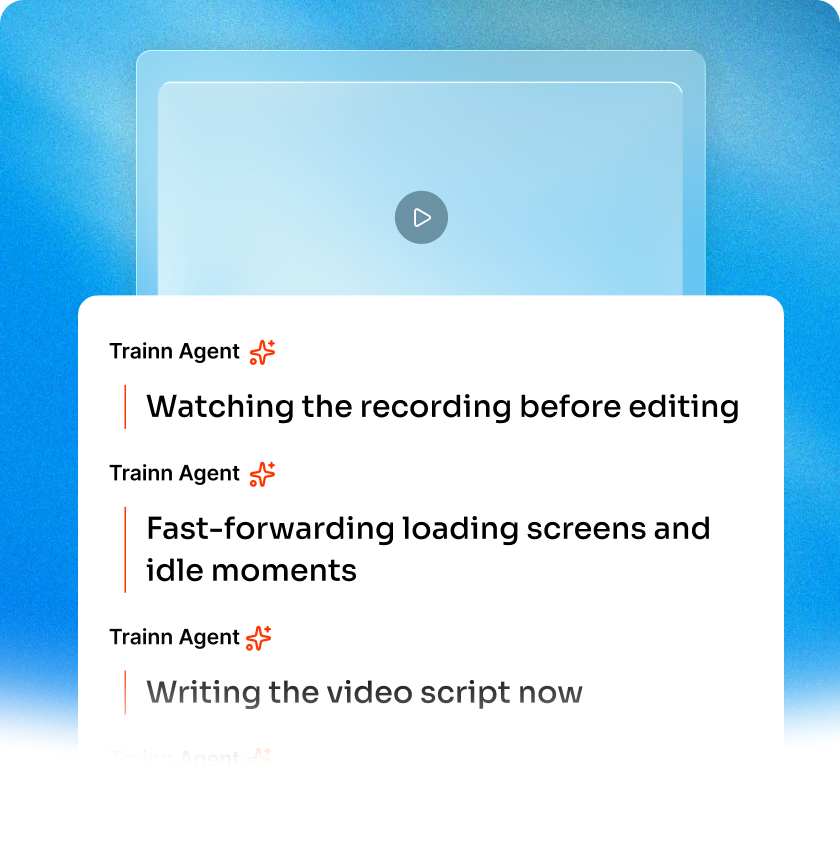
The same recording also produces a help video: the AI video agent writes and voices the narration (or cleans up your own voice), adds contextual zooms and spotlights, and trims dead space.
AI-Powered Search & Recommendations
Customers get answers that understand intent, not just keyword matches, with relevant content surfaced automatically as they browse.
Translate into Any Language
One-click translation of both the written content and any video voiceover. Not limited to a fixed set of languages.
AI Features to Power Your Knowledge Base at Scale
0% Manual Writing
You record, the AI video agent does the rest. It writes the article or guide description and structures the content. The first draft is the one you'd confidently publish.
Consistent Quality, Every Creator
Every piece of help content comes out to the same clear, branded format regardless of who created it. No editorial review needed to catch inconsistent formatting.
Content That Survives Product Changes
A UI change means swapping one clip or updating one step, not rewriting the whole article. Your knowledge base stays accurate without a manual audit every release.
Who Uses an AI Knowledge Base?
Deflect recurring tickets
Support teams use Trainn's AI knowledge base to deflect recurring tickets with content that understands imprecisely worded questions, resulting in fewer tickets on issues already covered.
A searchable reference during onboarding
CS teams use it to give customers a searchable reference during onboarding, resulting in fewer live onboarding calls needed per account.
Publish help the day a feature ships
Product teams use it to publish help content the same day a feature ships, with AI recommendations surfacing it to the right customers automatically.
One reference every partner works from
Enablement teams use it as the shared, AI-searchable reference every partner works from, resulting in consistent answers regardless of how a partner phrases their question.
Self-serve answers without the exact term
Implementation leads use it to give new customers a self-serve reference that surfaces the right article even when they don't know the exact term to search for.
Fewer trial users abandon setup
Growth teams use it to reduce the number of trial users who abandon setup after a failed manual search, since AI-powered search finds relevant help content even from a vague query.
Teams offering customer enablement at scale rely on AI-powered search to keep support consistent as the content library grows past what any one person can manually curate.
"People are feeling more pressed for time. Our customers always ask for quick 1-minute tutorial videos to learn the product. It took exactly 45 days to create over 100 tutorial videos, review, and publish the Learning Center on Trainn. Now we have a self-serve resource that customers can lean on and learn from."
Sabina Rana
Head of Support, BuildOps
Frequently Asked Questions
What is the best AI knowledge base for reducing support tickets?
The best AI knowledge base for ticket reduction combines AI-powered search that understands imprecise questions with content that's actually kept current. Trainn's AI knowledge base pairs intent-based search with the ability to generate the help videos and guides that go into it directly from screen recordings, so the content improves as fast as the search does.
How is an AI knowledge base different from a traditional one?
A traditional knowledge base search matches the exact words a customer types against article titles and text, so an imprecisely worded question can return nothing useful. An AI knowledge base understands intent, so a customer describing their problem in their own words still finds the right answer, and content recommendations can surface proactively rather than only through search.
Do I need an AI knowledge base if I already use a basic help center?
If your current help center relies on exact keyword matching, upgrading to AI-powered search is likely to reduce the number of customers who give up searching and open a ticket instead. The gap is usually most visible in search analytics — a high rate of zero-result searches is a strong signal that an AI knowledge base would catch questions your current search is missing.
Can an AI knowledge base create its own content?
Some can, and it's a meaningful difference between tools. Trainn's AI knowledge base generates help videos and step-by-step guides directly from screen recordings, rather than assuming the content already exists somewhere and just needs a home — which matters most for teams starting a knowledge base from scratch.
How does AI-powered search actually work in a knowledge base?
AI-powered search typically uses natural language understanding to interpret what a customer means, not just what they typed, matching that intent against the knowledge base's content even when the exact wording differs. This is what allows a vague or conversational question to still surface the right article or video.
Is there a free trial for Trainn's AI knowledge base?
Yes. Trainn offers a 14-day free trial, and pricing starts at $19/month. Sign up free — no credit card required.
Other AI-Powered Tools from Trainn
Trainn is an AI-powered product video and guide creation platform that turns screen recordings into product demo videos, training videos, onboarding videos, step-by-step guides, and interactive walkthroughs. Trainn also delivers this content externally through a branded no-code LMS, or in-app through embedded tutorials to train customers at scale.

North Bethesda, Maryland 20852


